
Modern greenhouse design plays a crucial role in improving crop quality, maximizing agricultural productivity, and creating an ideal growing environment. A well-designed agricultural greenhouse balances light exposure, temperature control, humidity management, and ventilation efficiency to support healthy plant growth throughout the year. Whether you are planning a commercial greenhouse, hydroponic greenhouse, or smart farming greenhouse project, understanding these greenhouse design principles is essential for long-term success.
The Importance of Light in Greenhouse Design
Light is one of the most important factors affecting photosynthesis and plant development in greenhouse farming. Proper greenhouse orientation and covering materials can maximize natural sunlight penetration and improve crop performance. Glass greenhouses and polycarbonate greenhouses are widely used because they offer excellent light transmission and energy efficiency.
For crops requiring supplemental lighting, LED grow lights are commonly integrated into modern smart greenhouse systems. In areas with intense sunlight, greenhouse shading systems can help prevent overheating and reduce plant stress. Selecting the right greenhouse covering material and light management system can significantly improve crop yield and quality.
Temperature Control for Stable Crop Growth
Maintaining the correct greenhouse temperature is critical for healthy plant growth and year-round production. Different crops require different temperature ranges, so greenhouse climate control systems should be designed according to the specific cultivation requirements.
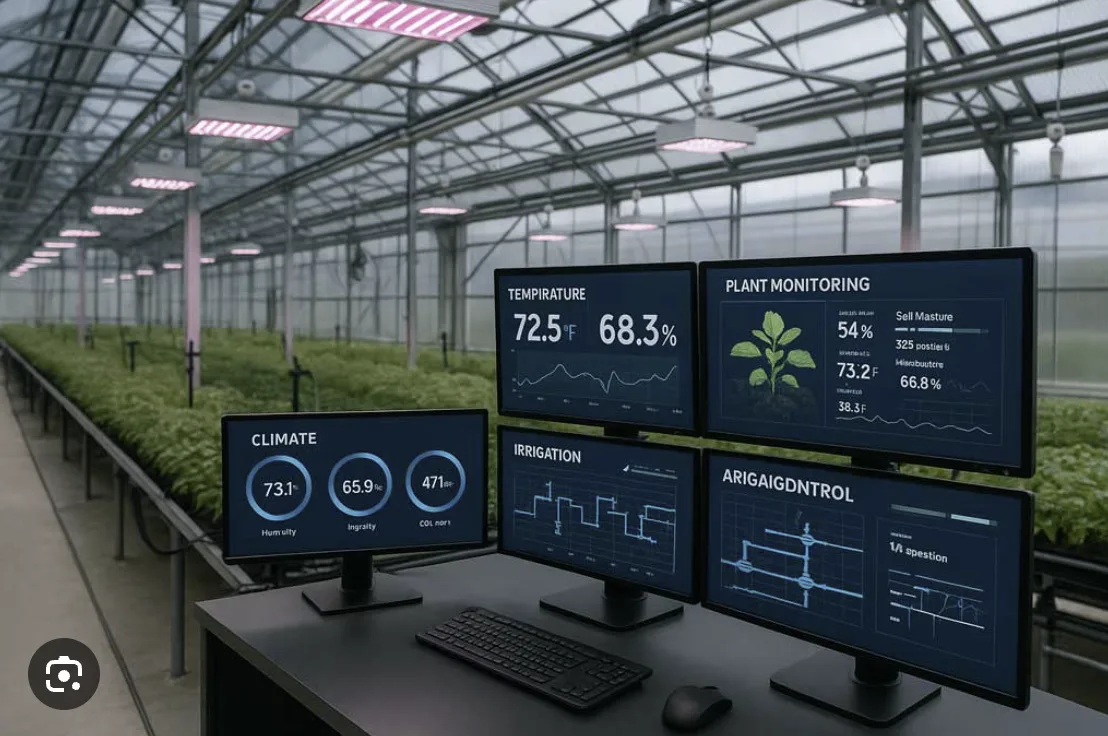
In colder climates, greenhouse heating systems such as hot water heating, air heaters, or thermal insulation curtains help maintain stable temperatures during winter. In hot regions, cooling pad systems, exhaust fans, and evaporative cooling technologies are commonly used to lower greenhouse temperatures effectively. Smart temperature monitoring systems also allow growers to automatically adjust environmental conditions and reduce energy consumption.
Humidity Management in Modern Greenhouses
Humidity control is another essential aspect of greenhouse environmental management. Excessive humidity can lead to fungal diseases, mold growth, and poor crop quality, while low humidity may slow plant development and increase water stress.
Modern greenhouse humidity control systems use ventilation, misting systems, and dehumidification equipment to maintain balanced moisture levels. Proper irrigation scheduling and air circulation also help stabilize humidity inside the greenhouse. For hydroponic greenhouse farming, precise humidity management is especially important to create an ideal growing environment for leafy vegetables and high-value crops.
Why Ventilation Is Essential for Greenhouse Efficiency
An effective greenhouse ventilation system helps regulate temperature, humidity, and carbon dioxide levels while improving airflow inside the growing space. Natural ventilation greenhouses use roof vents and side vents to create continuous air exchange, while mechanical ventilation systems rely on exhaust fans and circulation fans for climate management.
Good ventilation not only reduces heat buildup but also minimizes pest and disease risks in greenhouse cultivation. For large commercial greenhouse projects, automated ventilation systems can improve operational efficiency and support precision agriculture practices.
About Miilkiia
Miilkiia Official Website specializes in advanced greenhouse solutions and smart agriculture technologies for global growers. The company provides comprehensive greenhouse products and agricultural systems designed for commercial farming, hydroponic cultivation, and sustainable agriculture projects.
Miilkiia’s product portfolio includes multi-span greenhouses, glass greenhouses, tunnel greenhouses, hydroponic growing systems, vertical farming systems, greenhouse cooling systems, fertigation equipment, and intelligent environmental control systems. The company also offers customized greenhouse engineering solutions tailored to different climates and crop production requirements.
With strong technical expertise and extensive manufacturing experience, Miilkiia focuses on durable galvanized steel greenhouse structures, energy-efficient climate control technologies, and intelligent automation systems. These solutions help growers increase productivity, reduce labor costs, and improve long-term agricultural sustainability.
FAQ
What is the ideal temperature for a greenhouse?
Most greenhouse crops grow well between 18°C and 30°C, depending on the plant variety and growth stage.
Why is ventilation important in a greenhouse?
Ventilation helps control temperature, humidity, airflow, and carbon dioxide levels while reducing disease risks.
Which greenhouse covering material provides the best light transmission?
Glass greenhouse panels generally provide the highest light transmission, while polycarbonate sheets offer a balance of insulation and durability.
How can humidity be controlled inside a greenhouse?
Humidity can be managed through ventilation systems, misting equipment, dehumidifiers, and proper irrigation scheduling.
What is the benefit of a smart greenhouse system?
Smart greenhouse systems automate climate control, improve crop management, reduce labor costs, and increase farming efficiency.