Which Is Better for High-Density Leafy Greens: a Hydroponic Tower or an NFT System?
For high-density leafy greens, the right choice between a hydroponic tower and an NFT hydroponic system depends on space, labor, and harvest goals. In most commercial settings, the best answer is not universal; it is a match between crop density, airflow, and operational control.
High-Density Leafy Greens Need More Than Just Water
High-density leafy greens perform best when root oxygen, nutrient flow, and canopy spacing are managed together. Hydroponics is not only about growing without soil; it is about controlling the root zone, disease pressure, and production consistency.
Leafy crops such as lettuce, arugula, basil, and spinach are especially sensitive to crowding. According to the Food and Agriculture Organization, controlled environment systems are increasingly important for stable food production under land and climate constraints. That makes system selection a practical production decision, not just a design preference.
Hydroponic Tower vs NFT Hydroponic System: Core Difference
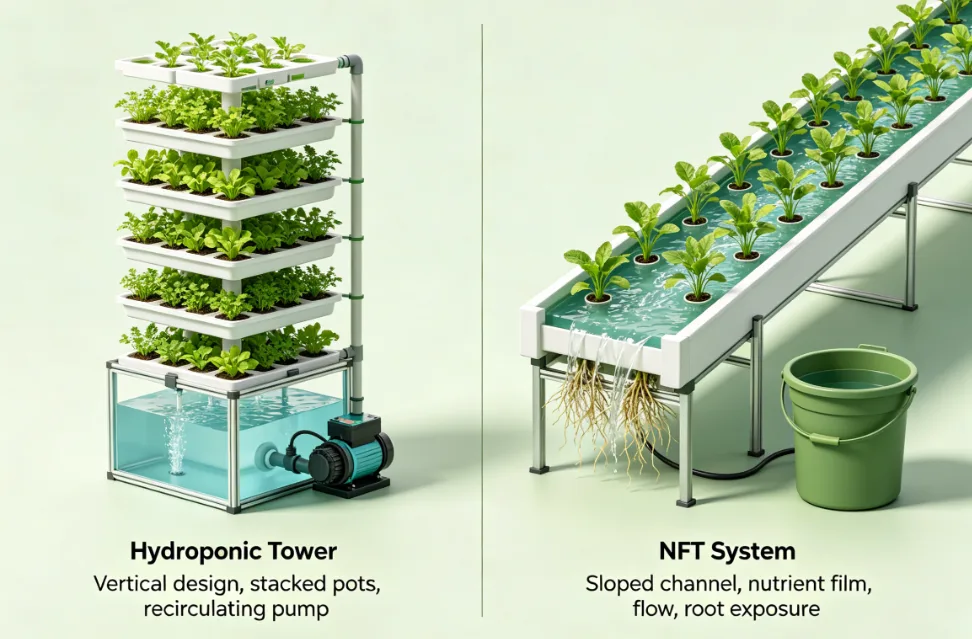
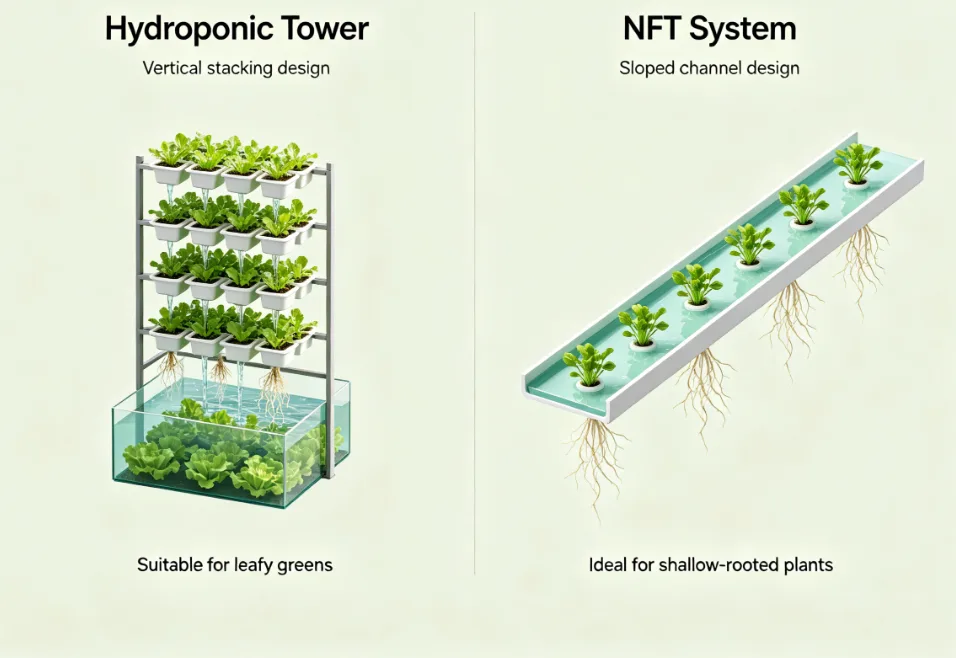
The main difference is geometry. A hydroponic tower uses vertical stacking to maximize plants per floor area, while an NFT hydroponic system uses shallow channels to move a thin film of nutrient solution across roots.
| Factor | Hydroponic Tower | NFT Hydroponic System |
|---|---|---|
| Space use | Very high vertical density | Efficient horizontal density |
| Airflow | Can be tighter and more complex | Usually easier to manage |
| Maintenance | More individual plant access points | More standardized channel care |
| Best use | Vertical farms, rooftops, compact sites | Commercial leafy greens, herbs, nurseries |
In simple terms, a hydroponic tower is a vertical density tool, while NFT is a flow management tool. If your project is limited by floor space, towers can create more growing positions. If your project is limited by labor efficiency and uniformity, NFT often wins.
When a Hydroponic Tower Is the Better Choice
A hydroponic tower is better when vertical yield per square meter matters most. This is common in urban farms, container farms, and branded demonstration sites where footprint is limited and visual impact matters.
Vertical systems also fit projects that need modular expansion. A tower can be added in stages, which helps operators test cultivar performance before scaling. For businesses exploring miilkiia’s hydroponic tower solutions, the main advantage is compact production in constrained spaces.
However, towers are not automatically superior for every leafy green crop. Dense vertical layouts can create uneven light distribution and airflow differences between upper and lower planting positions. That means towers need stronger monitoring and more disciplined irrigation control.
When an NFT Hydroponic System Is the Better Choice
An NFT hydroponic system is better when consistency, harvest speed, and operational simplicity are the priority. Commercial leafy green farms often prefer NFT because channels are easy to standardize, inspect, and clean.
NFT also supports predictable root-zone oxygenation when the slope, flow rate, and channel design are correct. The USDA Agricultural Research Service has published extensive controlled-environment research that supports the importance of root-zone management in hydroponic production. In practice, that means NFT can be highly efficient for lettuce and herbs when the system is well tuned.
For growers comparing NFT hydroponic system options, the strongest case is usually commercial repeatability. NFT is easier to train staff on, easier to sanitize, and easier to integrate into a larger greenhouse workflow.
Which System Produces Better High-Density Leafy Greens?
The better system depends on whether density means more plants per footprint or more reliable output per labor hour. A hydroponic tower usually wins on vertical density, while NFT usually wins on uniformity and day-to-day management.
| Production Goal | Better Option | Why |
|---|---|---|
| Maximum plants in a small footprint | Hydroponic tower | Uses vertical space efficiently |
| Uniform commercial harvests | NFT hydroponic system | More even light and nutrient delivery |
| Lower training complexity | NFT hydroponic system | Standardized channels are easier to manage |
| Urban or container deployment | Hydroponic tower | Compact and modular |
For most commercial leafy green operations, NFT is the safer default. For space-constrained projects, towers can produce more plants in less floor area. That is why many operators evaluate both systems before choosing a final layout.
What the Numbers Say About Controlled Environment Production
Controlled environment agriculture is growing because food systems need more stable output and less land pressure. The United Nations Sustainable Development Goal 2 highlights the need for resilient food production, and hydroponic systems are part of that broader shift.
Industry estimates suggest that leafy greens are among the most commercially suitable crops for hydroponics because of their short cycle time and compact canopy. In practical terms, that means both a hydroponic tower and an NFT hydroponic system can work well, but only if the project design matches the crop and climate.
Energy and climate control also matter. The U.S. Department of Energy notes that controlled environment agriculture can be energy intensive, so system efficiency should be considered alongside yield. In other words, the best system is the one that balances output with operating cost.
How to Choose Between a Hydroponic Tower and NFT
The right choice becomes clear when you compare site conditions, crop plan, and staffing. A compact urban site often favors towers, while a greenhouse focused on steady leafy green turnover often favors NFT.
- Choose a hydroponic tower if your site has limited floor space and you want maximum vertical density.
- Choose NFT if you want easier cleaning, simpler training, and more uniform production.
- Choose towers if your project is modular, small, or visually oriented.
- Choose NFT if your project is commercial, repeatable, and labor-sensitive.
For operators building a broader production platform, it can help to pair the system with greenhouse structure and climate control. A commercial greenhouse structure, proper ventilation, and reliable irrigation often matter as much as the hydroponic layout itself.
Operational Risks to Watch
System choice should also reflect risk. Towers can create uneven moisture distribution if pumps, emitters, or flow paths are not balanced. NFT can fail quickly if power loss or channel blockage interrupts nutrient flow.
That is why monitoring is essential in both systems. A good setup includes temperature, humidity, light, and EC tracking, plus alerting for pump failure. For larger projects, environment monitoring and IoT integration can reduce downtime and improve consistency.
Leafy greens also respond quickly to stress, so small mistakes can affect texture, color, and shelf life. In high-density production, the best system is the one that protects crop quality while keeping operations manageable.
Practical Recommendation for Growers
The most practical recommendation is to use NFT for commercial leafy green production and hydroponic towers for space-limited vertical projects. That rule covers most real-world cases, although local climate and labor availability can change the final decision.
If the goal is a scalable farm with predictable harvests, NFT is usually the stronger foundation. If the goal is to maximize output in a tight footprint, a hydroponic tower is often the better fit. For projects that need both, hybrid layouts are increasingly common.
Operators planning a new site should also consider greenhouse type, shading, ventilation, and irrigation design. Those systems shape the final result as much as the crop channel itself.
FAQ
Is a hydroponic tower better than NFT for lettuce?
A hydroponic tower can be better when floor space is extremely limited, but NFT is usually better for commercial lettuce farms. NFT offers more uniform nutrient delivery, easier cleaning, and simpler workflow control. For most growers, that makes NFT the safer default for consistent leafy green quality.
Does NFT use less water than a hydroponic tower?
Both systems recirculate nutrient solution, so both can be water efficient. NFT often feels easier to manage because the flow path is simpler and losses are easier to control. A tower may need more careful balancing to avoid uneven wetting, which can affect water use efficiency.
Which system is easier to maintain?
NFT is usually easier to maintain because channels are standardized and accessible. Towers have more vertical components and can require more attention to flow balance, cleaning, and plant access. If labor simplicity matters, NFT is generally the more practical choice for high-density leafy greens.
Can a hydroponic tower work in a commercial farm?
Yes, a hydroponic tower can work in a commercial farm, especially in urban or container-based production. The key is to manage light, airflow, and irrigation carefully. Towers are best when space efficiency matters more than absolute operational simplicity or traditional greenhouse workflow.
What should I choose for a new leafy greens project?
If you want predictable commercial output, start with NFT. If your site is small and vertical space is available, consider a hydroponic tower. The best choice depends on your footprint, labor model, and crop targets. For many operators, a site-specific design review is the smartest next step.