
What Are the Benefits of Drip Hydroponic Systems?
Drip hydroponic systems combine precise nutrient delivery with strong water efficiency, making them a practical choice for commercial growers. For growers comparing hydroponic irrigation options, drip-based setups often stand out for their flexibility, crop control, and compatibility with efficient hydroponics goals.
Why Drip Hydroponic Systems Matter in Modern Hydroponic Irrigation
Drip hydroponic systems matter because they deliver nutrient solution directly to the root zone in measured amounts. That simple principle reduces waste, improves consistency, and supports water-saving hydroponics in greenhouses, container farms, and controlled-environment projects.
In commercial agriculture, water efficiency is not a minor benefit; it is a core operating advantage. The Food and Agriculture Organization reports that agriculture accounts for about 70% of global freshwater withdrawals, which is why irrigation efficiency has become a strategic priority. Drip hydroponic systems help address that pressure by applying water and nutrients more precisely than many traditional methods.
How Drip Hydroponic Systems Work
A drip hydroponic system works by pumping nutrient solution through lines and releasing it through emitters near each plant. The result is targeted hydroponic irrigation that can be adjusted by crop type, growth stage, climate, and substrate.
Unlike flood-based methods, drip delivery can be paired with substrates such as coco coir, rockwool, or other inert media. This makes efficient hydroponics easier to scale for fruiting crops, leafy greens, and nursery production. In practice, the system can be configured for recirculating or drain-to-waste operation depending on water quality, disease risk, and management goals.
| Feature | Drip Hydroponic Systems | Common Benefit |
|---|---|---|
| Delivery method | Point-by-point emitters | Precise root-zone feeding |
| Water use | Low to moderate | Supports water-saving hydroponics |
| Crop fit | Broad | Works for vegetables, berries, and ornamentals |
| Scalability | High | Suitable for commercial expansion |
Key Benefits of Drip Hydroponic Systems
The first major benefit is water efficiency. Because the nutrient solution is delivered close to the plant, less water is lost to runoff, evaporation, or uneven distribution. For growers focused on hydroponic irrigation performance, that can translate into lower operating costs and better resource control.
The second benefit is nutrient precision. Drip hydroponic systems make it easier to match feeding schedules to crop demand, which improves consistency across a crop cycle. This is especially useful in efficient hydroponics programs where uniformity matters for harvest timing and product quality.
The third benefit is crop versatility. Drip systems can support high-value fruiting crops, such as tomatoes and cucumbers, as well as strawberries and many nursery plants. That flexibility is one reason commercial operators often choose drip hydroponic systems for mixed production strategies.
The fourth benefit is better root-zone management. When the irrigation schedule is tuned correctly, plants receive both moisture and oxygen in a balanced way. That balance is important because root health affects growth rate, disease pressure, and overall yield stability.
Where Drip Hydroponic Systems Fit Best
Drip hydroponic systems fit best where control, repeatability, and crop-specific feeding are priorities. They are widely used in greenhouses, especially in multi-span facilities where irrigation zones can be managed separately. Miilkiia’s greenhouse systems and irrigation systems are examples of how hydroponic irrigation can be integrated into a larger production layout.
These systems are also a strong fit for substrate-based fruit and vegetable production. For growers who need stable delivery, drip hydroponic systems can be paired with growing systems designed for commercial throughput. In many projects, that combination is more practical than a one-size-fits-all approach.
- Commercial greenhouse vegetables
- Strawberries and other berry crops
- Nursery and transplant production
- Urban and modular farming projects
- Controlled-environment specialty crops
Drip Hydroponic Systems vs Other Hydroponic Irrigation Methods
Drip hydroponic systems are often compared with NFT, ebb-and-flow, and deep water culture. Each method has strengths, but drip irrigation usually offers the broadest crop compatibility. That is why it is often selected when efficient hydroponics must support multiple crop types or variable climate conditions.
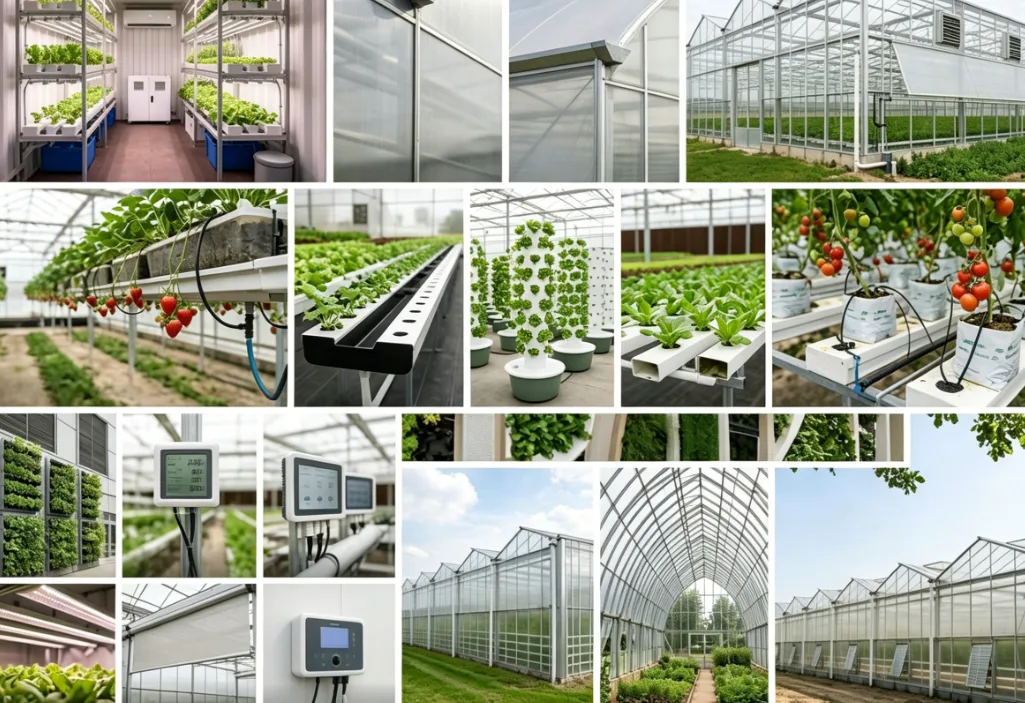
NFT is often better for lightweight leafy greens, while deep water culture suits high-volume leafy production. Drip systems, by contrast, are more adaptable to larger plants and fruiting crops. For commercial growers, that adaptability can reduce the need to redesign the entire production line when the crop plan changes.
| Method | Best For | Main Limitation |
|---|---|---|
| Drip hydroponics | Broad crop range | Requires emitter maintenance |
| NFT | Leafy greens | Less suitable for heavy crops |
| Deep water culture | Fast leafy production | Limited crop diversity |
| Ebb-and-flow | Propagation and trays | Less precise feeding |
Operational Advantages for Commercial Growers
The operational advantage of drip hydroponic systems is control. Growers can adjust flow rate, irrigation frequency, and nutrient concentration with a high degree of precision. That control supports efficient hydroponics by reducing guesswork and making crop response easier to monitor.
Another advantage is compatibility with automation. Drip hydroponic systems can be connected to timers, sensors, and climate controls, which improves consistency and reduces labor dependence. The U.S. Environmental Protection Agency WaterSense program emphasizes efficient water use in irrigation, and the same logic applies in controlled-environment agriculture: precise delivery helps reduce waste while maintaining plant performance.
For larger projects, drip systems also support phased expansion. A grower can start with one zone and add more lines, benches, or greenhouse bays later. That modularity is valuable for projects that need to balance capital cost with long-term growth.
Design Considerations for Better Hydroponic Irrigation
Good design is essential because even efficient hydroponics can perform poorly if the layout is weak. Emitter spacing, pump sizing, filtration, drainage, and nutrient tank management all affect system reliability. In commercial settings, poor filtration or uneven pressure can quickly create crop inconsistency.
Climate also matters. In hot regions, evaporation and plant demand rise, so irrigation timing may need to be more frequent. In cooler regions, overwatering can become a greater risk. For that reason, drip hydroponic systems should be designed around crop species, local weather, and production targets rather than generic assumptions.
Miilkiia’s greenhouse structure and system categories show how hydroponic irrigation is usually part of a broader production ecosystem. In practice, the best results come from combining structure, coverage, ventilation, and irrigation into one coordinated plan.

Why Drip Hydroponic Systems Support Water-Saving Hydroponics
Drip hydroponic systems support water-saving hydroponics because they reduce unnecessary delivery and make reuse easier in recirculating designs. That is especially important in regions where water cost, availability, or regulation affects farm economics.
According to the UN-Water water scarcity overview, water stress is a growing global issue, and agricultural users are under increasing pressure to improve efficiency. Drip hydroponic systems do not solve scarcity alone, but they are one of the most practical tools for reducing avoidable loss in controlled production.
For growers, the business case is straightforward: less waste, more control, and better crop uniformity. Those three outcomes are often more valuable than a single headline yield number, especially in commercial operations where consistency drives profitability.
Conclusion: Are Drip Hydroponic Systems Worth It?
Drip hydroponic systems are worth considering when precision, flexibility, and water efficiency matter. They are especially useful for commercial growers who need reliable hydroponic irrigation, scalable production, and a practical path toward efficient hydroponics.
For many projects, the strongest advantage is not one feature alone, but the combination of targeted feeding, modular expansion, and crop adaptability. That is why drip hydroponic systems remain one of the most widely used approaches in modern water-saving hydroponics.
FAQ
1. What crops work best with drip hydroponic systems?
Drip hydroponic systems work well for tomatoes, cucumbers, peppers, strawberries, and many nursery crops. They are also useful for ornamentals and other plants that need controlled root-zone feeding. Because the system is flexible, growers can adjust irrigation schedules and nutrient strength to match different crop stages and climate conditions.
2. Are drip hydroponic systems more water-efficient than soil irrigation?
In many commercial settings, yes. Drip hydroponic systems deliver nutrient solution directly to the root zone, which reduces runoff and unnecessary evaporation. When designed well, they can support water-saving hydroponics more effectively than many conventional soil-based irrigation methods, especially in greenhouse and substrate-based production.
3. Do drip hydroponic systems require a lot of maintenance?
They require regular maintenance, but the tasks are manageable. Growers should check emitters, filters, pumps, and nutrient tanks on a routine schedule. Maintenance is important because clogging or pressure imbalance can affect crop uniformity. With proper filtration and monitoring, the system can remain stable and efficient over time.
4. How do drip hydroponic systems compare with NFT?
Drip hydroponic systems are generally more versatile than NFT. NFT is often better for leafy greens, while drip systems can support a wider range of crops, including fruiting plants and strawberries. For growers who need efficient hydroponics across multiple crop types, drip systems usually offer more flexibility.
5. Can drip hydroponic systems be automated?
Yes. Drip hydroponic systems can be automated with timers, sensors, controllers, and climate management tools. Automation improves consistency and reduces labor dependence, which is especially valuable in commercial production. It also helps growers fine-tune hydroponic irrigation based on crop demand, weather, and growth stage.