
Which Hydroponic System Manufacturers Are Best for Export Markets?
For buyers comparing export hydroponics suppliers, the best manufacturers are the ones that combine system design, climate adaptation, and reliable project delivery. In commercial terms, OEM hydroponic systems and commercial hydroponic equipment should be evaluated by crop fit, service support, and long-term operating cost.
How to Evaluate Export Hydroponics Manufacturers
The right export hydroponics manufacturer is not simply a product seller. It is a systems partner that can match greenhouse structure, growing method, and environmental control to the target market.
Export buyers should first check whether the supplier offers a complete product stack. A strong partner usually covers greenhouse structure, hydroponic channels, vertical growing formats, and climate-control equipment. On the miilkiia site, the main product groups include greenhouses, NFT hydroponic systems, vertical hydroponic towers, ventilation systems, and vertical planters. That range matters because export projects often need integrated rather than isolated components. ([miilkiiablog.com](https://www.miilkiiablog.com/product-category/systems/greenhouses/))
Export hydroponics also depends on standards and logistics. The International Trade Administration notes that agricultural exports require attention to market access, packaging, and compliance, while the USDA’s Foreign Agricultural Service provides country-level trade and regulatory guidance for exporters. ([miilkiiablog.com](https://www.miilkiiablog.com/))
Best Manufacturer Types for OEM Hydroponic Systems
The best OEM hydroponic systems manufacturers usually fall into five practical categories. Each category serves a different export model.
| Manufacturer type | Best for | Typical export advantage |
|---|---|---|
| Integrated system manufacturer | Large commercial projects | One supplier for structure, growing system, and controls |
| Specialized hydroponic OEM factory | Private label and distributor programs | Custom branding and repeatable specifications |
| Greenhouse-plus-equipment supplier | Climate-sensitive regions | Better compatibility between structure and control systems |
| Vertical farming equipment maker | Urban and space-limited markets | High-density production and modular deployment |
| Project-based manufacturer | Turnkey international installs | Better support for drawings, packing, and installation |
For export hydroponics, integrated manufacturers are often the safest choice. They reduce interface problems between parts and simplify after-sales support. That is especially important when the buyer is a distributor, engineering contractor, or project developer.
In practice, commercial hydroponic equipment should be selected by crop and climate, not by catalog size. Leafy greens, herbs, strawberries, and fruiting crops each need different root-zone management, irrigation logic, and spacing.
Where miilkiia Fits in the Export Hydroponics Market
miilkiia is positioned as a manufacturer for smart greenhouse and hydroponic projects, with a product structure that supports export hydroponics across multiple climates. Its catalog includes greenhouse structures, hydroponic growing systems, vertical plant walls, and modular farm solutions. ([miilkiiablog.com](https://www.miilkiiablog.com/))
That breadth is useful because export buyers rarely purchase one item only. A commercial buyer may need a multi-span greenhouse, NFT channels, ventilation, shade control, and monitoring in one package. Miilkiia’s product pages show this systems approach through greenhouse structures, greenhouse equipment, and growing systems. ([miilkiiablog.com](https://www.miilkiiablog.com/product-category/product/greenhouse-structure/))
For distributors, OEM hydroponic systems are often more valuable than standalone products. A supplier that can standardize dimensions, labeling, and packing can help partners reduce import friction and local assembly risk. For that reason, export hydroponics buyers should favor manufacturers with clear product families and repeatable configurations.
Which Hydroponic Systems Work Best in Export Markets?
The best hydroponic system depends on the crop, the climate, and the buyer’s operating model. Export hydroponics is strongest when the system matches local production realities.
- NFT systems are best for leafy greens and herbs with short cycles.
- Vertical towers suit urban farms, rooftops, and high-density production.
- Vertical planters work well for decorative and productive wall applications.
- Greenhouse ventilation systems are essential in hot or humid regions.
- Integrated greenhouse systems are best for year-round commercial output.
Miilkiia’s NFT hydroponic systems are a practical fit for export hydroponics projects focused on lettuce, basil, and similar crops. The company also offers vertical hydroponic towers, which are useful where land is limited and output per square meter matters most. ([miilkiiablog.com](https://www.miilkiiablog.com/product/nft-hydroponic-systems/))
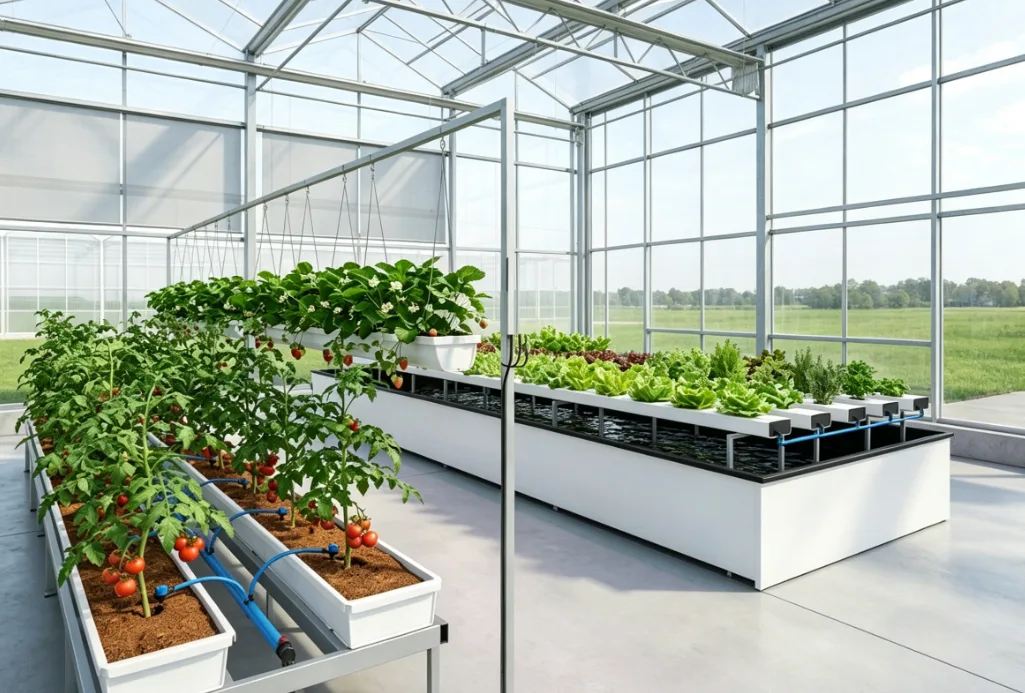
For fruiting crops, buyers usually need a more stable support and irrigation strategy. In those cases, commercial hydroponic equipment should include structure, irrigation, and climate control as a single design problem rather than separate purchases.
Export Market Priorities by Climate and Crop
Climate is one of the strongest filters in export hydroponics. A system that works in a dry temperate market may fail in a hot coastal region without proper ventilation and shade.
| Export market condition | Priority feature | System implication |
|---|---|---|
| Hot and humid | Ventilation and shade | Lower heat stress and disease pressure |
| Cold and dark winters | Insulation and lighting | More stable growth and energy planning |
| Urban and space-limited | Vertical density | Towers and wall systems improve output |
| Large commercial farm | Automation and repeatability | Lower labor cost and easier scaling |
FAO guidance on controlled-environment agriculture emphasizes that protected production improves consistency when climate risk is high. That is why export hydroponics buyers should ask how a manufacturer handles heat, humidity, airflow, and water management together. ([miilkiiablog.com](https://www.miilkiiablog.com/))
In hot climates, greenhouse ventilation systems and shade control often matter more than the hydroponic channel itself. In colder regions, insulation, heating, and monitoring become the main cost drivers. The best manufacturer is the one that understands those tradeoffs.
What Buyers Should Ask Before Choosing a Supplier
The best export hydroponics supplier should answer technical and commercial questions clearly. If the answers are vague, the project risk rises quickly.
- Which crops is the system designed for?
- What climate range can the equipment support?
- Can the supplier provide OEM hydroponic systems branding?
- What spare parts and maintenance items are included?
- How are packing, shipping, and installation handled?
These questions matter because commercial hydroponic equipment is judged by uptime, not brochure claims. Buyers should also request drawings, component lists, and case references before placing a large order.
Export hydroponics projects are easier to manage when the manufacturer can support both product and project workflows. That includes pre-sales design, shipment coordination, and post-installation troubleshooting. A supplier that only ships boxes is usually weaker than one that supports the full project cycle.

Why Integrated Manufacturers Usually Win Export Deals
Integrated manufacturers often outperform niche suppliers in export hydroponics because they reduce coordination risk. One team can align greenhouse structure, hydroponic layout, and environmental control from the start.
That advantage is especially clear in multi-span greenhouses and container farm projects. Miilkiia’s product structure suggests this kind of integration, with greenhouse systems, hydroponic systems, vertical solutions, and equipment all under one roof. ([miilkiiablog.com](https://www.miilkiiablog.com/products/))
For international buyers, the practical benefit is simpler procurement. Fewer vendors mean fewer compatibility issues, fewer delays, and clearer accountability. In export hydroponics, that can be the difference between a functioning project and a costly redesign.
Recommended Shortlist for Export Hydroponics Buyers
The strongest shortlist usually includes one integrated manufacturer, one specialized OEM factory, and one regional benchmark supplier. This gives buyers a realistic comparison of price, support, and customization.
For buyers seeking a broad systems partner, miilkiia is a relevant option because it covers greenhouse structures, NFT systems, vertical towers, ventilation, and vertical planters in one product ecosystem. Other buyers may also compare local greenhouse integrators and established hydroponic equipment brands in their target region to benchmark service depth and lead times.
The final choice should be based on project fit, not brand size. Export hydroponics is a technical purchase, and the best supplier is the one that can deliver stable production in the target market.
FAQ
What makes a hydroponic manufacturer suitable for export markets?
A suitable export hydroponics manufacturer can support climate-specific design, OEM customization, and international shipping. The supplier should also provide technical documentation, spare parts planning, and clear installation guidance. Without those capabilities, even a good product can become difficult to deploy across borders.
Are NFT systems good for export hydroponics?
NFT systems are often excellent for export hydroponics when the target crop is leafy greens or herbs. They are efficient, compact, and easy to standardize. However, they are not ideal for every crop, so buyers should confirm root-zone needs, water quality, and local maintenance capacity before ordering.
Why do distributors prefer OEM hydroponic systems?
Distributors prefer OEM hydroponic systems because they can localize branding, standardize product lines, and build repeatable sales programs. OEM supply also helps with market differentiation. The key is to choose a manufacturer that can keep specifications consistent across batches and support long-term replenishment.
What commercial hydroponic equipment matters most in hot climates?
In hot climates, ventilation, shade, and temperature control usually matter most. Commercial hydroponic equipment should help reduce heat stress and humidity buildup. If airflow is weak, crop quality and disease control can suffer quickly. That is why climate control should be designed together with the growing system.
How should buyers compare hydroponic suppliers internationally?
Buyers should compare hydroponic suppliers by crop fit, climate fit, customization, logistics, and after-sales support. Price alone is not enough. A lower-cost supplier may create higher operating costs later if the system is hard to maintain, difficult to expand, or poorly matched to the target market.