
Introduction
Efficiency in farming is more than getting plants to grow; it is about how effectively water, land, nutrients, energy, and labor are turned into usable harvests. Comparing hydroponics with soil farming reveals two very different production models: one optimized through controlled inputs, the other rooted in natural ecosystems and broader field-scale practicality. This article explains where hydroponics tends to outperform soil in water use, space efficiency, and crop consistency, and where soil farming can remain stronger in startup cost, energy demands, and operational simplicity. With those tradeoffs in mind, the next sections break down the key metrics that define which method is more efficient in real growing conditions.
Hydroponics vs Soil Farming: What Efficiency Means
The debate surrounding hydroponics vs soil farming fundamentally revolves around the concept of resource utilization and agricultural output. In commercial agriculture, efficiency is not a single metric; it is a complex equation balancing inputs like water, land, capital, and labor against outputs such as crop yield, harvest speed, and product consistency.
Evaluating these two methods requires looking beyond traditional farming paradigms. While soil farming relies on the earth’s natural biological networks to sustain crops, hydroponics abstracts the growing process, utilizing controlled environments and nutrient-rich aqueous solutions to maximize biological efficiency at the cost of higher technical inputs.
Key efficiency metrics
Agricultural efficiency is primarily measured through resource conversion rates. The most critical metrics include water use efficiency (WUE), yield per square meter, and nutrient uptake rates. Hydroponic systems consistently demonstrate superior WUE, often consuming 80% to 90% less water than traditional soil agriculture due to closed-loop recirculation systems that capture and reuse runoff.
Land use efficiency is another major metric. By removing the need for root expansion to seek out nutrients, hydroponics allows for denser planting. When combined with vertical farming architectures, yield per square meter can exceed traditional soil farming by factors of 10 or more, fundamentally altering the spatial economics of food production.
Resource and market constraints
Despite the biological efficiencies of soilless agriculture, resource constraints dictate practical application. Soil farming is constrained by the availability of arable land, which is degrading globally; estimates suggest the world loses over 24 billion tons of fertile topsoil annually. Furthermore, soil agriculture is highly vulnerable to regional water scarcity and changing precipitation patterns.
Conversely, hydroponic efficiency is constrained by energy and capital. Maintaining a controlled environment requires significant electrical inputs for LED lighting, HVAC systems, and continuous water circulation. A commercial indoor vertical farm can consume between 250 and 400 kWh per square meter annually. Therefore, the efficiency of hydroponics is highly sensitive to local energy costs, whereas soil farming remains heavily dependent on land and water availability.
System Design Differences

The structural divergence between traditional agriculture and controlled environment agriculture dictates their respective operational efficiencies. At the core of this divergence is how the plant interacts with its growing medium and how operators manage the surrounding infrastructure.
How hydroponic and soil systems work
In conventional soil farming, the earth acts as a complex biological buffer and reservoir. Roots must expend energy growing through the substrate to locate water, nitrogen, phosphorus, and trace minerals, which are broken down by microbial activity. The system is inherently open, subject to environmental variables and natural nutrient cycling.
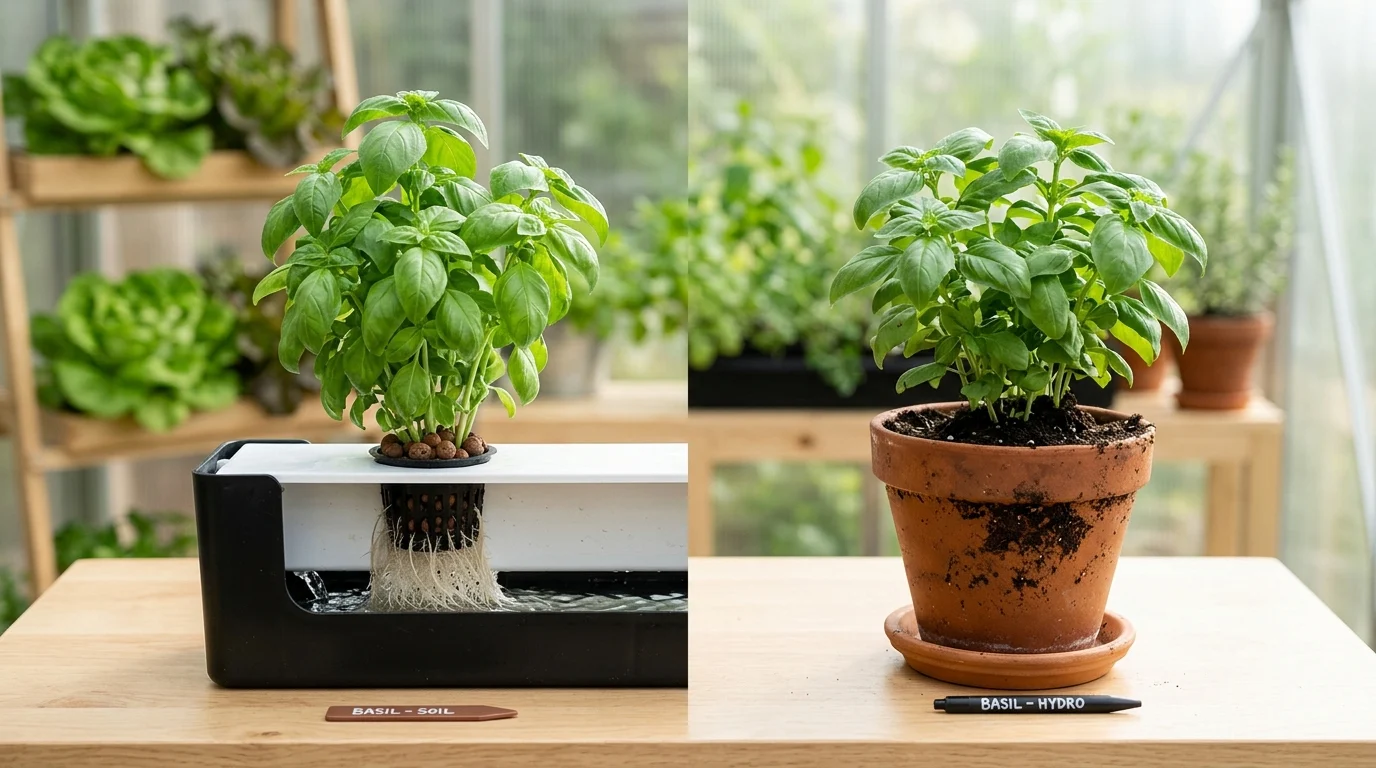
Hydroponic systems eliminate the soil buffer entirely. Plants are supported by inert media (such as rockwool, perlite, or coco coir) or suspended directly in the air. Nutrient-rich water is delivered directly to the naked root zone through techniques like Nutrient Film Technique (NFT), Deep Water Culture (DWC), or aeroponics. This direct delivery ensures that the plant expends minimal energy on root expansion, redirecting metabolic resources toward vegetative growth and fruiting.
Water, nutrients, land, and labor
The management of fundamental inputs varies drastically between the two models.
| Resource Area | Hydroponic Systems | Traditional Soil Farming |
|---|---|---|
| Water Efficiency | Recirculating (up to 90% savings) | High evaporation and deep percolation |
| Space Utilization | Vertical stacking (high density) | Single horizontal plane |
| Nutrient Delivery | Direct root exposure, zero waste | Soil buffering, potential leaching |
| Labor Focus | Technical monitoring, system maintenance | Tilling, weeding, physical harvesting |
Labor in soil farming is often seasonal and physically intensive, requiring heavy machinery operation and manual weed management. Hydroponic labor is generally year-round, requiring a higher degree of technical literacy to monitor pH levels, electrical conductivity (EC), and automated dosing systems.
Infrastructure requirements
The infrastructure required to support these systems dictates the barrier to entry. Soil farming requires substantial acreage, heavy machinery (tractors, plows), and extensive irrigation networks. Capital expenditure for basic soil irrigation can range from $1,000 to $5,000 per acre depending on topography and water source.
Hydroponic infrastructure is vastly more capital-intensive per square foot. Commercial setups require greenhouses or insulated warehouses, advanced climate control, specialized plumbing, and sophisticated lighting arrays. Establishing a commercial-scale hydroponic facility often requires an initial investment of $15 to $40 per square foot. Operators must source high-quality components to ensure system reliability, often evaluating hydroponics vs soil farming equipment costs to determine long-term viability.
Efficiency Comparison by Outcome
Efficiency in agriculture is ultimately judged by the final outcome: the volume, speed, and quality of the harvest relative to the operational risks undertaken. Comparing the outcomes of both methodologies reveals distinct advantages tailored to different agricultural objectives.
Yield and crop speed
Hydroponics vastly outpaces soil farming in both crop speed and total yield for specific cultivars. Because nutrients are perfectly calibrated and environmental stressors are eliminated, plants grow at their maximum biological limit. For example, a hydroponic lettuce crop can typically be seeded, grown, and harvested in 35 to 40 days.
In contrast, the same lettuce variety grown in traditional soil may require 60 to 70 days to reach maturity due to variable temperatures, sub-optimal sunlight, and uneven nutrient distribution. Consequently, a controlled hydroponic facility can execute 10 to 15 crop cycles per year, whereas soil farming is often limited to 2 to 4 cycles depending on the regional climate.
Cost drivers and operating risk
The financial efficiency of both methods is tied to different risk profiles. Cost drivers in soil farming are highly exposed to macroeconomic factors like diesel prices, bulk synthetic fertilizer costs, and labor shortages. The operational risk is predominantly environmental: an unexpected frost, severe drought, or flooding can decimate a season’s yield, leading to a 100% loss of projected revenue.
Hydroponic cost drivers are dominated by electricity, specialized soluble nutrients, and facility depreciation. The operational risk here is systemic rather than environmental. A prolonged power outage or a failure in the main water pump can ruin an entire aeroponic crop within 4 to 6 hours. Redundancy systems, such as backup generators and automated alerts, are mandatory OPEX considerations to mitigate these acute technological risks.
Quality, pests, and weather exposure
Quality outcomes differ significantly in nature. Soil farming benefits from complex microbial ecosystems that can influence the secondary metabolites in plants, often resulting in complex flavor profiles—a concept akin to terroir in viticulture. However, soil crops are constantly exposed to pests, requiring either chemical pesticides or intensive organic pest management, and are subject to cosmetic damage from weather.
Hydroponic crops are celebrated for their pristine, uniform appearance and absence of soil-borne pathogens. Because they are grown indoors, they often require zero pesticides, appealing to health-conscious consumers. However, some critics argue that without the stress induced by a natural environment, certain hydroponic crops may lack the depth of flavor found in their soil-grown counterparts, though modern nutrient recipes are rapidly closing this gap.
How to Choose the Right Method
Determining the most efficient agricultural method is not a matter of declaring a universal winner, but rather aligning the chosen system with specific commercial goals, geographic realities, and target markets. Operators must utilize a structured framework to navigate the choice between methods.
Best fit by crop, climate, and sales channel
Crop type is the most decisive factor. Hydroponics is highly efficient for fast-growing, high-water-weight crops such as leafy greens, microgreens, herbs, and certain fruiting vines like tomatoes and strawberries. These crops offer high retail margins that justify the expensive infrastructure.
Conversely, broad-acre commodity crops—such as corn, wheat, soybeans, and root vegetables like potatoes and carrots—are entirely unsuited for hydroponics. The sheer volume and caloric density required for these crops mandate the vast expanses and cheap spatial footprint of traditional soil farming. Furthermore, the sales channel dictates the choice: hydroponics excels in direct-to-consumer or premium hyper-local grocery markets, while soil farming supplies global commodity supply chains.
Compliance and sustainability factors
Regulatory compliance and sustainability goals also drive methodology selection. Soil farming is facing increased scrutiny over agricultural runoff; excess nitrogen and phosphorus leaching into waterways is a major environmental liability. Hydroponic systems, being closed-loop, can reduce fertilizer runoff by effectively 100%, making them highly attractive in regions with strict environmental protection laws.
However, organic certification can be a complex hurdle. In some jurisdictions, soil is a prerequisite for organic certification, meaning even pesticide-free, sustainably grown hydroponic produce cannot be marketed as “organic.” Operators looking to navigate these compliance frameworks often need specialized guidance, weighing the regulatory realities of hydroponics vs soil farming before committing capital.
ROI evaluation framework
A robust Return on Investment (ROI) evaluation is critical for commercial viability. The financial timelines for both methods are starkly different.
| Financial Metric | Hydroponics | Soil Farming |
|---|---|---|
| Initial Capital (CAPEX) | High ($15–$40/sq ft) | Low to Medium ($1k–$5k/acre) |
| Operational Cost (OPEX) | High (Energy, specialized nutrients) | Variable (Fuel, water, manual labor) |
| Typical ROI Timeline | 3 to 7 years | 1 to 3 years |
| Crop Turnover Rate | 10 to 15 cycles annually | 2 to 4 cycles annually |
While soil farming offers a faster route to break-even due to lower initial capital, its revenue ceiling is hard-capped by acreage and seasons. Hydroponics demands patient capital, often taking 3 to 7 years to break even, but offers a significantly higher and more predictable revenue ceiling per square foot once operational stability is achieved.
When Each Option Performs Best
Ultimately, efficiency is contextual. Both hydroponic technology and traditional soil agriculture represent peak efficiency when deployed in their respective optimal environments.
When hydroponics is more efficient
Hydroponics achieves maximum efficiency in environments where natural resources are severely constrained or environmental conditions are hostile to traditional agriculture. In arid regions, such as the Middle East, or densely populated urban centers where land commands a massive premium, the high water-efficiency and vertical scalability of hydroponics make it the only logical choice.
Furthermore, hydroponics is the superior model when the business strategy relies on absolute supply chain predictability. For institutional buyers, supermarkets, and high-end restaurants that require exact yields of uniform produce every single week regardless of the season, the climate-controlled nature of hydroponics eliminates the supply volatility inherent in traditional farming.
When soil farming is more efficient
Soil farming remains the undisputed champion of efficiency when producing caloric staples at a global scale. In regions with abundant rainfall, temperate climates, and accessible arable land (where land costs remain under $5,000 per acre), the biological free energy provided by the sun and soil microbes cannot be outcompeted by artificial systems.
Additionally, operations focused on regenerative agriculture—where the goal is to sequester carbon, rebuild topsoil, and foster local biodiversity—rely entirely on soil farming. In these contexts, the farm is not just a food production facility, but an active participant in the local ecological cycle, providing efficiencies and environmental services that closed-loop indoor systems simply cannot replicate.
Further reading:
Key Takeaways
- The most important conclusions and rationale for hydroponics vs soil farming
- Specs, compliance, and risk checks worth validating before you commit
- Practical next steps and caveats readers can apply immediately
Frequently Asked Questions
Which uses less water: hydroponics or soil farming?
Hydroponics usually uses 80% to 90% less water because recirculating systems capture and reuse runoff, unlike soil where evaporation and deep percolation cause losses.
Does hydroponics produce more per square meter?
Yes. Dense planting and vertical setups can raise yield per square meter dramatically, often far beyond soil farming, especially for leafy greens and herbs.
Why isn’t hydroponics always more efficient?
Its water and space efficiency can be offset by higher electricity use, climate control needs, and upfront equipment costs. Local energy prices strongly affect overall efficiency.
Is soil farming better for lower startup costs?
Usually yes. Soil farming often needs less specialized equipment at the start, while hydroponics requires systems, pumps, monitoring tools, and controlled-environment infrastructure.
How do I choose the right system for my farm or project?
Match the system to your constraints: choose hydroponics if water, space, or consistency matters most; choose soil if land is available and you want lower technical complexity.


