
Introduction
Choosing the right greenhouse ventilation system depends less on a single “best” design and more on how well it controls temperature, humidity, and air movement for your crops and climate. The right setup can reduce heat stress, lower disease pressure, improve transpiration, and support more consistent growth throughout the season. In this article, you’ll see how natural, mechanical, and hybrid ventilation systems compare, which performance factors matter most, and how to match airflow strategy to greenhouse size, structure, and production goals.
How greenhouse ventilation affects crop performance
A properly engineered greenhouse ventilation system is the cornerstone of controlled environment agriculture, serving as the primary mechanism for regulating the internal microclimate. Without a reliable method for exchanging indoor air with the outdoor environment, a greenhouse rapidly becomes an inhospitable solar collector, compromising plant health and yield.
Temperature and humidity control
Temperature and humidity control dictate plant transpiration rates and nutrient uptake. Without active air exchange, internal temperatures can exceed ambient outdoor levels by 20°F to 30°F on sunny days, inducing severe heat stress. Maintaining a target Vapor Pressure Deficit (VPD) typically requires keeping relative humidity between 60% and 80%. This precise balance is impossible to sustain in a sealed, unventilated structure, as transpiring plants continuously dump moisture into the trapped air.
Air quality and disease pressure
Beyond thermal regulation, internal air quality is paramount for biological functions. Actively growing crops rapidly deplete ambient carbon dioxide during photosynthesis. In a tightly closed greenhouse, CO2 levels can plummet from a baseline of 400 parts per million (ppm) down to 200 ppm within just a few hours, severely bottlenecking plant growth. Furthermore, stagnant air encourages fungal pathogens like Botrytis cinerea and powdery mildew. Investing in a robust greenhouse ventilation system ensures continuous air replacement, replenishing CO2 and disrupting the humid microclimates where fungal spores thrive.
Signs of poor ventilation
Commercial operations with inadequate airflow often observe distinct physiological symptoms in their crops before broader failures occur. Widespread condensation forming on the glazing, stunted vegetative growth, and localized calcium deficiencies—such as tip burn in lettuce or blossom end rot in tomatoes—are clear indicators that the transpiration stream is compromised. When the boundary layer of air around the leaf remains completely still, the plant cannot effectively cool itself or transport vital minerals.
Types of greenhouse ventilation systems
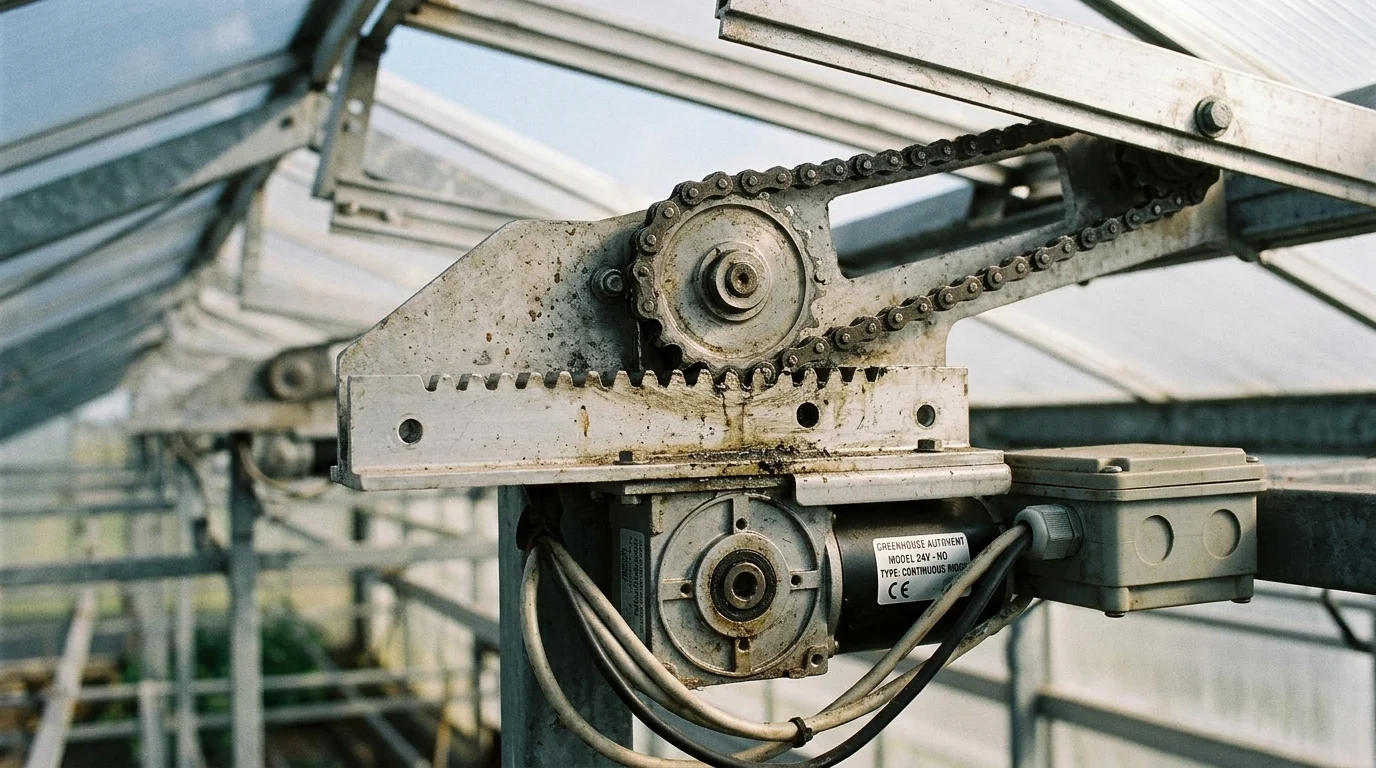
Greenhouse operators can choose from several distinct ventilation methodologies, each relying on different physical principles to exchange internal air with the external environment. Selecting the right architecture depends heavily on the scale of the facility and local weather patterns.
Natural ventilation
Natural ventilation relies on thermal buoyancy (the stack effect) and wind pressure to drive air exchange without mechanical assistance. As warm air rises and escapes through roof or ridge vents, cooler external air is naturally drawn in through sidewall roll-ups or louvers. For this passive approach to be effective, the total open vent area must typically equal 15% to 20% of the greenhouse floor area. While highly cost-effective to operate, natural ventilation is entirely dependent on unpredictable weather conditions and external wind speeds.
Forced ventilation
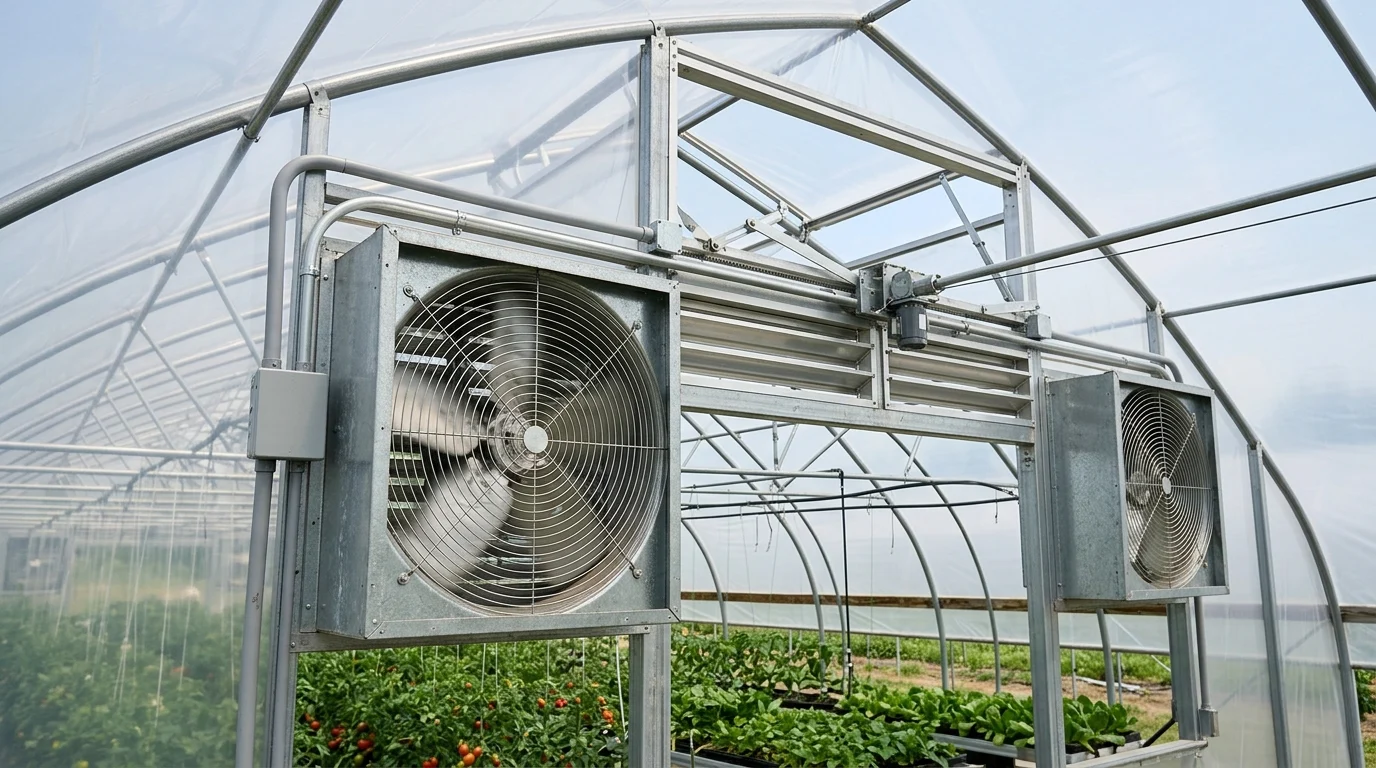
Forced ventilation utilizes mechanical exhaust fans to actively pull air out of the structure, drawing fresh outdoor air through motorized intake louvers located on the opposite gable end. This method guarantees a precise, measurable air exchange rate, typically engineered to replace the entire volume of greenhouse air exactly once per minute during peak summer cooling operations. Forced systems provide absolute control, making them mandatory in regions with extreme summer heat.
Hybrid systems and key components
Hybrid systems combine passive roof venting with mechanical fan assistance to optimize both energy efficiency and climate control across different seasons. A critical component of hybrid setups is the inclusion of Horizontal Airflow (HAF) fans. These internal circulation fans operate independently of the primary exhaust system to keep air moving horizontally across the plant canopy, homogenizing the climate even when the main exhaust fans are idle.
| System Type | Primary Mechanism | Energy Consumption | Control Precision | Best Application |
|---|---|---|---|---|
| Natural | Wind & Thermal Buoyancy | Very Low (motors only) | Low to Moderate | Mild climates, low-density crops |
| Forced | Exhaust Fans | High | Very High | Extreme heat, high-density crops |
| Hybrid | Vents + Fans + HAF | Moderate | High | Variable climates, year-round growing |
How to compare ventilation system performance
Selecting the appropriate equipment requires a careful evaluation of performance metrics to ensure the system meets the biological demands of the specific crop and the structural constraints of the facility.
Air exchange rate and airflow uniformity
The foundational metric for any ventilation setup is the air exchange rate, measured in Cubic Feet per Minute (CFM). A standard baseline for summer cooling in temperate climates is 8 CFM per square foot of greenhouse floor space. Additionally, airflow uniformity is critical to prevent isolated hot spots. Internal circulation fans should be positioned to maintain a continuous air velocity of 50 to 100 feet per minute (fpm) directly across the crop canopy, ensuring uniform temperature and humidity distribution from wall to wall.
Climate and crop suitability
System performance is heavily influenced by external climatic conditions and the specific physiological needs of the crop. In arid desert environments, forced ventilation is almost always paired with evaporative cooling pads (wet walls) to dramatically lower incoming air temperatures. Conversely, in highly humid coastal regions, drawing in external air may not effectively reduce internal moisture levels. In these zones, operators must balance ventilation rates with specialized mechanical dehumidification to protect moisture-sensitive crops like cannabis or dense ornamentals.
Controls, redundancy, and maintenance
A high-performing system requires sophisticated environmental controls and a rigorous maintenance schedule to prevent catastrophic failures. Automated controllers use integrated temperature and humidity sensors to stage fan operation, preventing rapid short-cycling and reducing energy waste. Redundancy must be built into the electrical design so that a single motor or relay failure does not compromise the entire crop. Routine mechanical maintenance, such as checking fan belt tension every 500 operating hours and cleaning louver hinges, is essential to preserve CFM ratings. Facilities looking to audit or upgrade their current performance metrics can partner with us for expert consultation.
How to size and implement a ventilation system
Proper sizing and implementation dictate the mechanical success of the ventilation strategy. An undersized system leads to chronic overheating and disease outbreaks, while an oversized system wastes electricity, creates damaging turbulence, and causes excessive wear on mechanical components.
Assess greenhouse dimensions and load
The sizing process begins with calculating the total internal volume of the greenhouse (Length × Width × Average Height). However, this baseline volume is only the starting point. Engineers must also account for solar heat load, glazing material light transmission, and geographic elevation. Because air is less dense at higher altitudes, systems installed above sea level require increased volumetric capacity; a standard engineering rule is to add 4% to the total CFM requirement for every 1,000 feet of elevation.
Specify equipment and automation
Once the total required CFM is determined, specific fans must be selected based on their performance under resistance. Greenhouse exhaust fans are typically rated at a Static Pressure of 0.10 to 0.15 inches of water gauge (in. w.g.) to account for the drag created by insect screens, intake louvers, and the friction of the crop canopy itself. Sourcing a robust greenhouse ventilation system ensures that the manufacturer’s stated CFM holds true under these real-world operating pressures, rather than just in free-air laboratory conditions.
Plan installation and operation
Installation geometry is just as important as the raw equipment capacity. To prevent dead air zones and short-circuiting of airflow, exhaust fans should generally be spaced no more than 25 feet apart along the leeward wall. Intake louvers must be properly sized to prevent starving the fans of air; the total area of the intake louvers should be 1.25 to 1.5 times the total area of the exhaust fan openings. This specific ratio ensures that intake air velocity remains below 250 feet per minute, minimizing turbulent drafts that could physically damage delicate crops located near the intake wall.
Choosing the best system for your greenhouse
The final decision rests on balancing agronomic needs with capital and operational budgets. There is no universally perfect setup, but rather an optimal configuration tailored to each unique commercial operation.
Best options by climate
In mild, temperate climates with consistent ambient breezes, a naturally ventilated structure featuring automated ridge and sidewall vents offers the best long-term return on investment. In contrast, extreme climates—such as high desert or deep tropical zones—mandate forced ventilation. High ambient summer temperatures require the sheer volume turnover of mechanical fans to prevent catastrophic crop loss during heatwaves, making passive systems inadequate regardless of their cost savings.
Best options by crop and layout
The physical architecture of the crop also dictates the ideal system choice. Tall, vining crops like greenhouse tomatoes or cucumbers create significant windbreak effects, necessitating powerful forced air and strategically placed HAF fans to push air through the dense lower canopy. Conversely, low-profile bench crops like bedding plants, seedlings, or microgreens may thrive with gentler natural ventilation supplemented by light overhead circulation, as there is less physical biomass obstructing the airflow.
Cost versus efficiency tradeoffs
Operators must carefully evaluate the tradeoff between initial capital expenditure and ongoing electrical costs. Fan efficiency is measured by the Fan Efficiency Ratio (FER), expressed as CFM per Watt of electricity consumed. High-efficiency fans featuring variable speed drives or specialized blade designs may cost 20% to 30% more upfront but often deliver over 20 CFM/Watt. This significantly reduces long-term utility bills compared to cheaper, standard-efficiency fans that yield only 12 to 15 CFM/Watt.
| Ventilation Configuration | Estimated Initial Cost ($/sq ft) | Operating Energy Cost | Typical Efficiency Rating (CFM/Watt) |
|---|---|---|---|
| Passive Natural Vents | $1.50 – $2.50 | Very Low | N/A (Passive) |
| Standard Forced Fans | $2.00 – $3.50 | High | 12 – 15 |
| High-Efficiency Forced | $3.00 – $5.00 | Moderate | 20 – 25+ |
Further reading:
Key Takeaways
- The most important conclusions and rationale for greenhouse ventilation system
- Specs, compliance, and risk checks worth validating before you commit
- Practical next steps and caveats readers can apply immediately
Frequently Asked Questions
What is the best greenhouse ventilation system for most growers?
A hybrid system is usually best because it combines roof or side vents with exhaust and HAF fans for better year-round control and energy efficiency.
When should I choose forced ventilation over natural ventilation?
Choose forced ventilation in hot climates, large houses, or high-density crops where you need predictable cooling and about one full air change per minute in summer.
How do I know my greenhouse ventilation is inadequate?
Common signs include condensation on glazing, heat buildup, high humidity, weak growth, and issues like tip burn, blossom end rot, mildew, or Botrytis.
How much vent area does a naturally ventilated greenhouse need?
A common target is total open vent area equal to about 15% to 20% of the greenhouse floor area for effective passive airflow.
Why are HAF fans important in a greenhouse ventilation system?
HAF fans keep air moving across the canopy, reduce hot and humid pockets, and make temperature and humidity more uniform between exhaust cycles.


