
Introduction
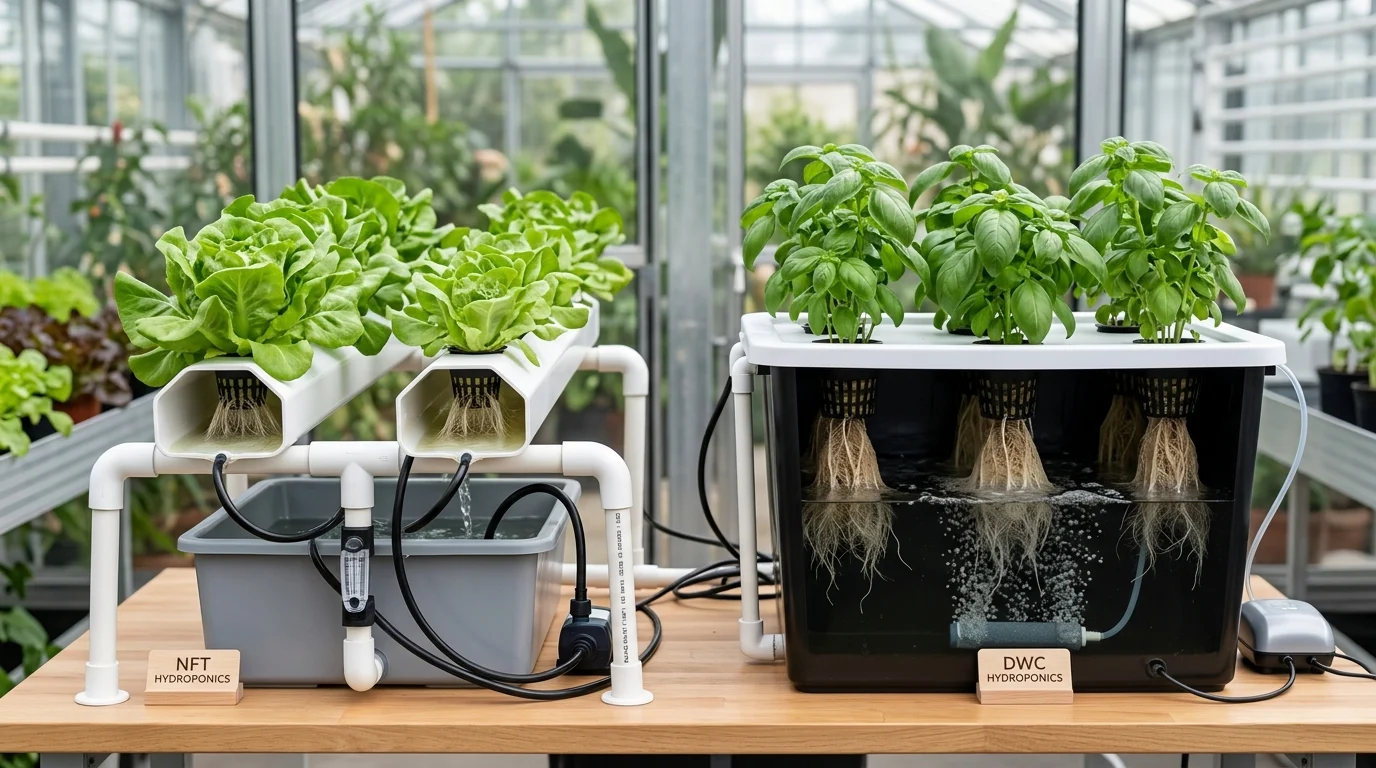
Choosing between Nutrient Film Technique and Deep Water Culture shapes far more than plant placement: it affects facility design, oxygen management, labor demands, crop risk, and long-term operating costs. Although both are recirculating hydroponic systems, they support roots in very different ways, which leads to meaningful differences in yield stability, water efficiency, maintenance, and scalability. This article compares NFT and DWC through the factors that matter most to growers, including root-zone conditions, crop suitability, infrastructure needs, and commercial performance, so you can see which method is more likely to deliver better results for your production goals.
Why NFT vs DWC Matters for Commercial Growers
The fundamental choice between Nutrient Film Technique (NFT) and Deep Water Culture (DWC) dictates the structural engineering, operational workflows, and ultimate profitability of a commercial hydroponic facility. While both methods fall under the umbrella of active liquid-culture hydroponics, their distinct approaches to root zone management require operators to make an early, irreversible commitment to a specific facility architecture.
Choosing incorrectly can lead to inflated operational expenditures, chronic crop loss, and severe scalability bottlenecks. Understanding the exact mechanical and biological differences between these systems is essential for achieving a rapid return on capital expenditure (CAPEX).
Defining success metrics
Commercial viability relies on precise yield and resource utilization metrics. A standard commercial greenhouse operating an optimized DWC system can target yields of 50 to 65 kilograms per square meter annually for head lettuce. In contrast, NFT configurations, which allow for denser plant spacing during early growth stages but require aisle space for maintenance, typically yield between 45 and 55 kilograms per square meter annually.
Water use efficiency (WUE) also serves as a critical baseline. Highly calibrated recirculating systems of both types should consume no more than 1.5 to 2.0 liters of water per head of lettuce from seedling to harvest. System selection depends on which method reliably hits these benchmarks given the local climate and labor availability.
Matching systems to crops and facility models
The decision must align with the specific operational scale and target crop profile. For facilities exceeding 10,000 square feet (approximately 930 square meters) dedicated to long-term, single-crop production, evaluating different hydroponic systems becomes a matter of balancing initial capital expenditures against ongoing labor costs.
DWC is predominantly favored for massive, monolithic lettuce or leafy green operations due to its highly automatable harvesting processes and uniform nutrient distribution. Conversely, NFT offers modularity, making it highly effective for multi-crop facilities that need to quickly reconfigure channel spacing to accommodate varying plant morphologies, from basil to specialized Asian greens.
System Design Differences Between NFT and DWC
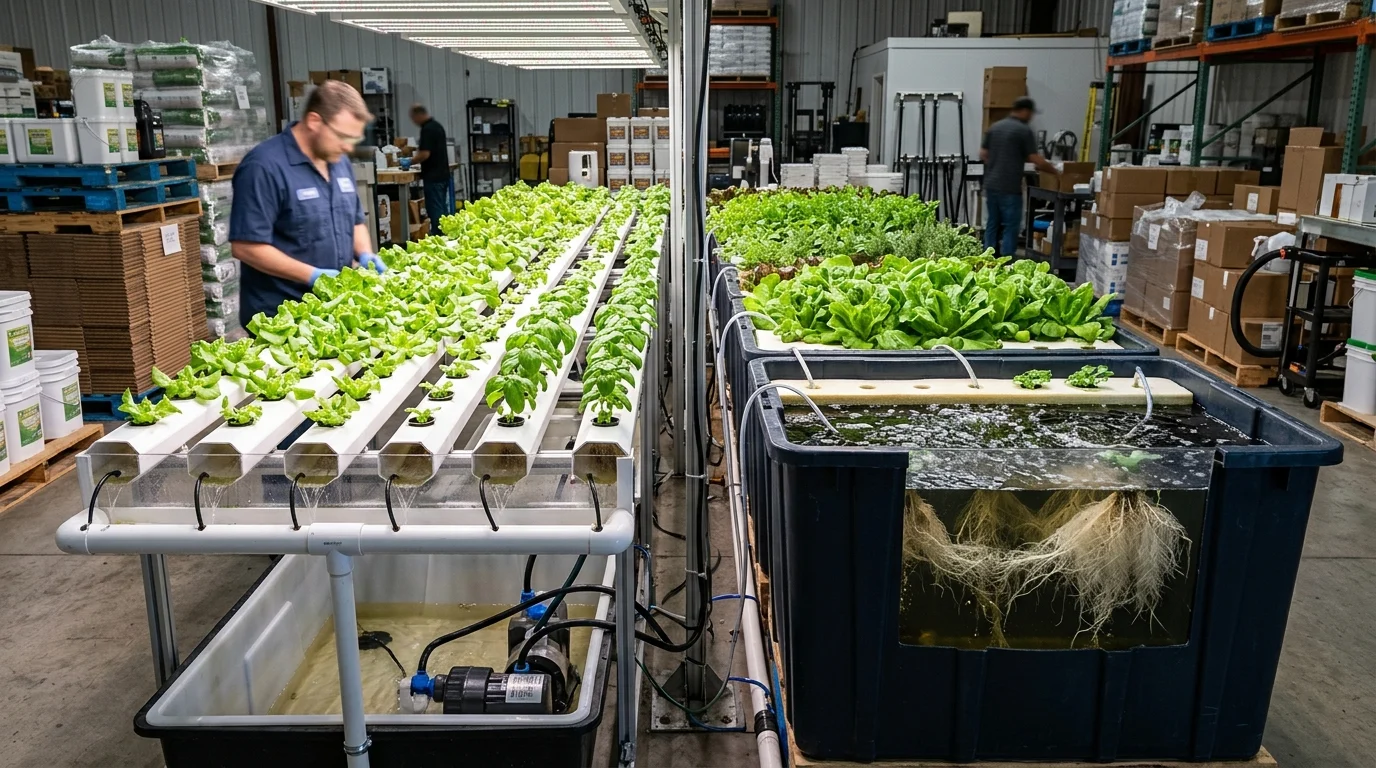
The engineering divergence between NFT and DWC is rooted in fluid dynamics and volumetric water retention. These structural variations directly impact climate control requirements, nutrient dosing precision, and the physical footprint of the growing apparatus.
Flow and channel design
NFT systems rely on a continuous, shallow stream of nutrient solution flowing down a precisely angled channel. Industry standards dictate a slope of 1.5% to 2.0% (a drop of 1 in 50 to 1 in 75) to maintain a solution depth of just 1 to 3 millimeters. Flow rates must be carefully calibrated to deliver 1.0 to 2.0 liters per minute per channel; exceeding this submerges the roots and restricts oxygen uptake, while falling short risks desiccation.
DWC, alternatively, utilizes static ponds or raceways that maintain a constant water depth of 20 to 30 centimeters (8 to 12 inches). Plants are suspended on floating high-density polyethylene (HDPE) rafts, allowing roots to hang freely in the nutrient solution without the physical constraints of a narrow channel.
Oxygenation, nutrient delivery, and water temperature
Because NFT roots are exposed to the ambient air within the channel, they naturally absorb atmospheric oxygen, eliminating the need for aggressive mechanical aeration of the solution. DWC relies entirely on dissolved oxygen (DO) maintained via industrial blowers and micro-pore diffusers, which must sustain DO levels strictly between 6.0 and 8.0 mg/L to prevent root asphyxiation.
However, DWC offers superior thermal mass. A standard commercial DWC pond holding 50,000 liters of water resists rapid temperature fluctuations. The minimal volume in an NFT system means the nutrient solution temperature will aggressively track ambient air temperatures, often necessitating inline chillers to maintain the optimal 18°C to 20°C (65°F to 68°F) range.
Failure points, labor, and maintenance
System resilience varies dramatically between the two methods. In an NFT array, a primary circulation pump failure becomes a catastrophic event within 2 to 4 hours, as the exposed roots quickly dry out under high-intensity lighting. DWC systems provide a massive buffer; plants can survive a pump failure for 48 to 72 hours without permanent wilting, provided DO levels do not crash immediately.
Maintenance profiles also differ significantly. NFT requires frequent, labor-intensive cleaning of individual channels to remove biofilm and root debris between crop cycles. DWC requires periodic pond drainage and liner scrubbing, typically synchronized with facility-wide sanitation cycles rather than individual harvest events.
| Specification | NFT (Nutrient Film Technique) | DWC (Deep Water Culture) |
|---|---|---|
| Water Depth | 1 – 3 mm (flowing film) | 20 – 30 cm (static pond) |
| Flow Rate / Aeration | 1.0 – 2.0 L/min per channel | Continuous diffused air (DO 6-8 mg/L) |
| Thermal Buffering | Low (rapid temperature shifts) | High (massive thermal inertia) |
| Pump Failure Tolerance | 2 – 4 hours | 48 – 72 hours |
How to Compare NFT vs DWC Performance
Beyond foundational design, operators must rigorously evaluate how each system performs under commercial pressure. Yield outputs, financial metrics, and risk management profiles dictate the long-term viability of the chosen infrastructure.
Yield, growth rate, and product quality
Growth cycles exhibit minor but economically significant variations depending on the root environment. Commercial butterhead lettuce typically requires 35 to 40 days in a DWC system from transplant to a standard 150-gram harvest weight.
The same cultivar in an optimally tuned NFT system may reach harvest weight in 30 to 35 days due to the highly oxygenated root environment accelerating early vegetative growth. However, DWC often produces a more uniform crop canopy across a large footprint because the nutrient profile and temperature are perfectly consistent throughout the massive water body, reducing the edge-effect variations sometimes seen at the tail ends of 40-foot NFT channels.
Capital and operating cost drivers
When sourcing any hydroponic product, capital expenditure (CAPEX) and operating expenditure (OPEX) must be modeled accurately. NFT systems carry higher specialized hardware costs; food-grade, UV-stabilized PVC channels typically cost between $3.00 and $5.50 per linear foot, alongside the cost of specialized galvanized support framing.
DWC minimizes hardware complexity, utilizing food-grade EPDM or LDPE pond liners costing roughly $0.50 to $1.20 per square foot, though it requires substantial excavation or cinderblock retaining walls. On the OPEX side, DWC incurs higher continuous electrical costs due to the regenerative blowers required for aeration (often drawing 2 to 5 kW for a commercial pond), while NFT relies primarily on lower-wattage circulation pumps.
Disease risk, crop loss, and scalability
The epidemiological profiles of the two systems present distinct operational challenges. In DWC, a massive shared water volume means waterborne pathogens like Pythium or Phytophthora have direct access to every plant in the pond—potentially jeopardizing 10,000 to 20,000 heads simultaneously if biosecurity protocols fail. Strict UV sterilization and ozone treatments are mandatory.
NFT isolates plant roots to individual channels. While a pathogen will rapidly spread down a single trough, it will not immediately infect adjacent channels unless it recirculates through the central reservoir without adequate filtration. This compartmentalization allows growers to cull isolated rows before an outbreak becomes systemic.
| Financial & Risk Metric | NFT System | DWC System |
|---|---|---|
| Primary CAPEX Driver | Extruded channels, support frames | Pond liners, retaining walls, blowers |
| Primary OPEX Driver | Labor for channel sanitation | Electricity for continuous aeration |
| Pathogen Spread Risk | Linear (isolated to specific channels) | Volumetric (threatens entire pond) |
| Scalability Bottleneck | Plumbing complexity, uneven flow | Floor load limits, massive water weight |
How to Choose the Right System
Selecting the optimal system requires synthesizing crop physiology, facility constraints, and risk tolerance. There is no universally superior method; rather, there is an optimal configuration for specific commercial objectives.
Best-fit crops for each method
Crop morphology is a primary determinant when selecting a system. NFT is exceptionally well-suited for fast-growing, lightweight crops with modest root systems. Basil, specific varieties of leaf lettuce, and strawberries thrive in the shallow channels where their roots will not form dense mats that block fluid flow.
DWC is the industry standard for heavier, larger heading lettuces (such as Romaine or Iceberg) and robust leafy greens. The floating rafts provide essential physical support for top-heavy plants, and the deep water accommodates massive root networks without restricting nutrient access or causing channel overflows.
Site factors and utility constraints
Facility engineering often forces a decision before agricultural preferences are even considered. The most critical constraint is floor load capacity. Water weighs approximately 62.4 pounds per cubic foot (1,000 kg per cubic meter). A standard 12-inch deep DWC pond imposes a continuous dead load of over 65 pounds per square foot (psf), requiring heavily reinforced ground-level concrete slabs.
Retrofitting an existing warehouse with inadequate flooring for DWC is often cost-prohibitive. NFT systems, by contrast, are remarkably lightweight, typically imposing a dead load of only 15 to 25 psf. This makes NFT the only viable choice for second-story urban farms, rooftop greenhouses, and retrofitted light-industrial spaces lacking heavy load-bearing reinforcement.
Pilot testing and decision criteria
Before committing millions of dollars in CAPEX, commercial operators should execute a rigorous pilot phase. Deploying a 500 to 1,000 square foot test plot of both systems allows management to evaluate localized HVAC interactions, labor efficiency, and cultivar-specific performance.
Operators looking to formalize their expansion strategy or validate their system architecture can partner with us to access specialized engineering data and procurement frameworks. Ultimately, the decision criteria must heavily weight the facility’s structural limits, the local cost of electricity versus labor, and the specific market demands for crop uniformity and volume.
Further reading:
Key Takeaways
- The most important conclusions and rationale for NFT vs DWC Hydroponic Systems
- Specs, compliance, and risk checks worth validating before you commit
- Practical next steps and caveats readers can apply immediately
Frequently Asked Questions
Which system usually gives higher lettuce yield in commercial setups?
DWC often edges out NFT for head lettuce, with about 50–65 kg/m² annually versus 45–55 kg/m² for NFT when systems are well optimized.
When is NFT a better choice than DWC?
Choose NFT if you grow multiple leafy crops and need flexible channel spacing. It suits modular facilities that switch between basil, lettuce, and Asian greens more often.
Why do commercial growers often prefer DWC for large facilities?
DWC fits large single-crop operations because it supports uniform nutrient delivery, raft-based automation, and better resilience during short equipment interruptions.
What is the biggest operational risk with NFT systems?
Pump failure is the main risk. In NFT, exposed roots can dry within 2–4 hours under strong lights, so backup pumps and alarms are essential.
How can growers compare NFT and DWC equipment options on Miilkiiablog?
Review hydroponic systems and product categories on miilkiiablog.com, then compare crop type, facility size, labor needs, and CAPEX before selecting NFT or DWC.