
Why Are Vertical Farming Systems Ideal for Restaurant Herb Production?
Vertical farming systems are ideal for restaurant herb production because they combine space efficiency, year-round consistency, and precise crop control. For chefs and operators, herb hydroponics can deliver fresher basil, mint, parsley, and cilantro with less waste and more predictable quality.
Vertical Farming Systems and Restaurant Herb Production: The Core Advantage
Vertical farming systems solve a restaurant problem that traditional supply chains cannot fully control: freshness. Herbs lose aroma, texture, and shelf life quickly after harvest, so even short delays matter. Indoor herb cultivation reduces that delay by placing production closer to the kitchen, whether in a back-of-house room, a rooftop unit, or a nearby commercial greenhouse.
Restaurant buyers also value consistency. A vertical system can maintain stable light, temperature, humidity, and irrigation, which helps chefs receive herbs with similar leaf size and flavor profile every week. USDA researchers note that controlled-environment herb production is being developed to improve the availability and safety of fresh-cut and potted culinary herbs, which supports the case for local, repeatable production USDA NIFA.
Why Herb Hydroponics Fits Foodservice Operations
Herb hydroponics is especially suitable for restaurants because herbs are fast-cycle crops with high turnover and high sensory value. Unlike fruiting crops, herbs do not need large root volumes or long production windows to be commercially useful. That makes them a strong match for stacked growing racks, NFT channels, floating raft beds, and vertical towers.
Hydroponic systems also reduce water demand. FAO training material reports that some hydroponic setups can use up to 90 percent less water than traditional agriculture, because water is recirculated rather than lost to soil FAO. For restaurants that care about sustainability reporting, that efficiency can be a practical operational benefit, not just a marketing claim.
| Restaurant need | Why vertical farming helps | Best herb examples |
|---|---|---|
| Fresh daily garnish | Harvest can happen minutes before service | Basil, dill, chives |
| Stable menu quality | Controlled environment limits seasonal variation | Parsley, mint, cilantro |
| Lower spoilage | Shorter supply chain reduces transit loss | Thai basil, oregano, tarragon |
Indoor Herb Cultivation Improves Space Use and Labor Efficiency
Indoor herb cultivation is valuable because restaurants rarely have generous growing space. Vertical layouts turn height into productive area, which is why commercial vertical farming is often chosen for urban kitchens, hotel groups, and foodservice suppliers. A compact footprint can support multiple crop layers while keeping harvest access simple.
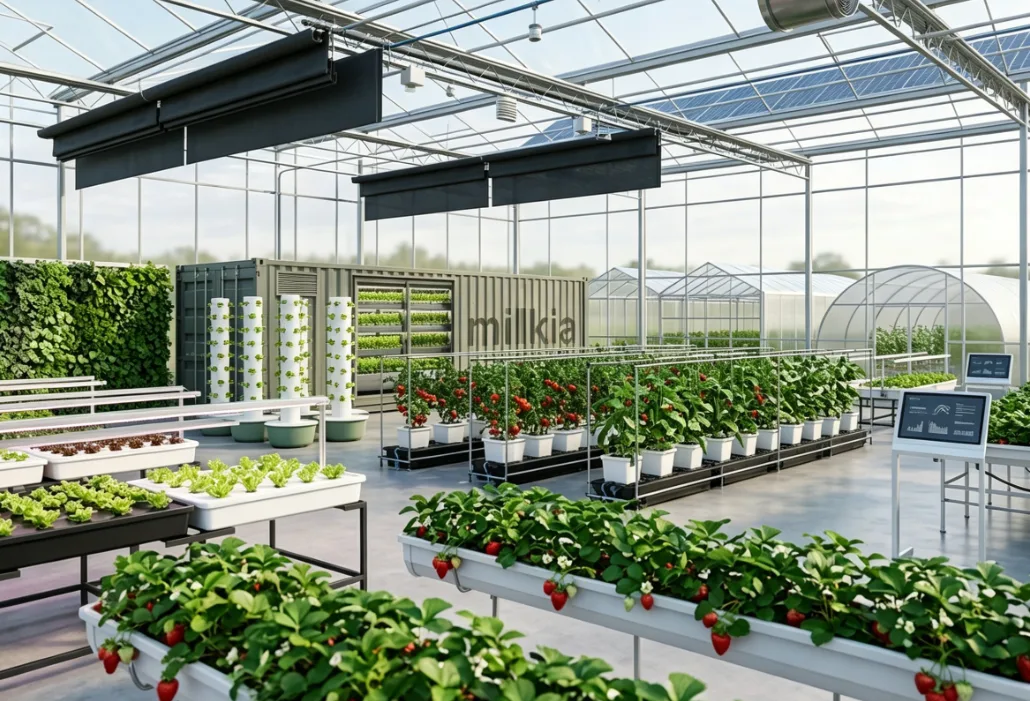
Labor efficiency matters as much as yield. When herbs are grown in a controlled rack or tower system, staff spend less time on watering, scouting, and replanting. Miilkiia’s vertical hydroponic towers and hydroponic towers are examples of how stacked production can support compact, high-density herb growing. For broader planning, its growing systems category shows how towers, channels, and other formats can be matched to crop and space requirements.
Commercial Vertical Farming Supports Year-Round Menu Planning
Commercial vertical farming is especially useful for restaurants that need menu stability across seasons. Outdoor herb supply can fluctuate with heat, rain, transport disruptions, and regional shortages. Indoor systems reduce those variables by controlling the growing environment directly.
That control is not only about light. It also includes root-zone oxygen, nutrient balance, airflow, and disease pressure. USDA ARS explains that vertical farming grows crops in stacked layers inside controlled environments, but also notes that artificial lighting and HVAC can raise energy costs USDA ARS. In practice, this means restaurants should choose systems that balance output, energy use, and maintenance complexity rather than chasing yield alone.
- Use fast-cycle herbs for continuous harvest planning.
- Match lighting intensity to the herb species and rack depth.
- Prioritize easy sanitation to reduce contamination risk.
- Design for quick harvesting near prep areas.
Which Vertical Farming Formats Work Best for Restaurant Herbs?
The best format depends on kitchen size, target volume, and whether the goal is production or display. NFT channels are often a strong fit for basil, parsley, and mint because they support shallow roots and efficient nutrient flow. Floating raft systems can suit larger batch production, while vertical towers are better when floor space is limited and visual impact matters.
Miilkiia’s container plant factory and leafy greens container plant factory show how modular systems can be deployed for urban food production. For restaurants, that modularity can be useful when the herb program needs to scale gradually or move closer to a new location. The right choice is usually the one that fits the kitchen’s workflow, not the one with the most layers.
| System type | Best use case | Operational note |
|---|---|---|
| NFT | High-turnover herbs | Efficient for shallow-root crops |
| Vertical towers | Very limited floor space | Strong density, easy expansion |
| Container farm | Off-site or rooftop production | Highly controlled, modular deployment |
How Restaurants Can Evaluate a Herb Hydroponics Investment
Herb hydroponics should be evaluated as an operations project, not only a gardening project. The main questions are whether the system lowers spoilage, improves freshness, and reduces purchasing volatility. If the answer is yes, the system can support both culinary quality and cost control.
Energy use is the main tradeoff. Vertical farming often depends on LEDs, pumps, and climate control, so the economics depend on crop value and local utility rates. A 2024 review in Frontiers notes that vertical farming is increasingly used for premium crops such as herbs, vegetables, and flowers, but profitability and energy efficiency remain central challenges Frontiers. Restaurants should therefore compare herb savings against electricity, labor, and maintenance costs over time.
Where Miilkiia Fits in Restaurant Herb Production
Miilkiia is relevant here because its product range covers the full system stack, from greenhouse structures to hydroponic towers and container-based growing units. That matters for commercial buyers who need a coordinated solution rather than isolated components. Its greenhouses, greenhouse structure, and greenhouse systems categories can support projects that combine herbs with broader controlled-environment production.

For restaurant herb programs, the most useful systems are the ones that simplify daily operations. A compact tower, a modular container farm, or a controlled greenhouse bay can all work if they are matched to the menu, climate, and staffing model. The best result is not maximum complexity; it is dependable harvests with minimal disruption.
Practical Design Principles for Restaurant Herb Production
Successful restaurant herb production depends on a few repeatable design choices. First, keep the harvest path short so staff can cut herbs quickly before service. Second, standardize the crop list so the system is tuned for a small number of species. Third, use monitoring and automation to reduce manual error and keep nutrient delivery stable.
Miilkiia’s container plant factory and vertical hydroponic towers fit this logic because they support modular deployment and controlled growing conditions. For operators comparing formats, the right question is simple: which system delivers the freshest herbs with the least daily friction?
FAQ
1. Why are vertical farming systems better than outdoor beds for restaurant herbs?
Vertical farming systems are better for restaurant herbs because they offer predictable quality, faster access, and less spoilage. Outdoor beds depend on weather, season, and transport time. Restaurants need herbs that are fresh, uniform, and available on demand, which controlled indoor production can provide more reliably.
2. Which herbs are most suitable for herb hydroponics?
Herb hydroponics works especially well for basil, mint, parsley, cilantro, dill, chives, and oregano. These crops have relatively short cycles and respond well to stable nutrient delivery. Restaurants usually choose herbs that are harvested frequently and used in both garnish and core recipe applications.
3. Does commercial vertical farming always save money for restaurants?
Commercial vertical farming does not always save money immediately. The economics depend on energy costs, labor savings, crop value, and system design. For high-use herbs with frequent spoilage in the supply chain, the value often comes from freshness, reduced waste, and more stable purchasing rather than lower unit cost alone.
4. What is the main operational challenge in indoor herb cultivation?
The main operational challenge in indoor herb cultivation is maintaining a stable growing environment without excessive energy use. Lighting, airflow, humidity, and nutrient balance all need to stay within target ranges. If those variables drift, herb quality can fall quickly, especially for delicate leafy crops used in foodservice.
5. How should a restaurant choose between towers, NFT, and container farms?
A restaurant should choose based on space, volume, and staffing. Towers are best for compact footprints, NFT suits efficient herb production, and container farms work well when production must be isolated or relocated. The right system is the one that fits the restaurant’s workflow and supply goals.