
Core Principles of Commercial Greenhouse Design for Maximum Yield
Commercial greenhouse design is a controlled-environment agriculture system engineered to optimize light, temperature, humidity, and CO₂ concentration for consistent crop output. According to the Food and Agriculture Organization, protected cultivation can increase yield by 2–5 times compared to open-field farming. Key conclusions include:
- Climate control directly determines photosynthetic efficiency.
- Structural design influences energy consumption and operational cost.
- Integrated systems improve yield stability across seasons.
These principles position greenhouse design as a multidisciplinary process combining engineering, agronomy, and environmental control technologies.
Site Selection and Orientation in Commercial Greenhouse Design
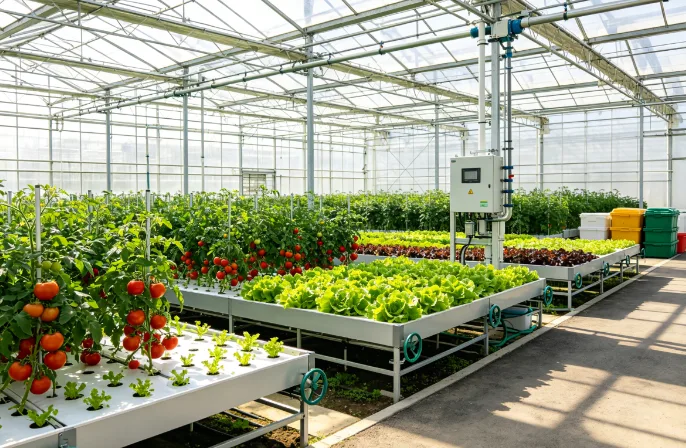
Site selection defines baseline efficiency for greenhouse operations. The U.S. Department of Energy highlights that solar orientation can improve natural light utilization by up to 20%. Optimal greenhouse orientation typically follows an east–west axis in higher latitudes to maximize winter sunlight exposure.
Key site selection parameters include:
- Solar radiation availability (measured in kWh/m²/year)
- Wind exposure and natural ventilation potential
- Proximity to water and energy infrastructure
Flat terrain reduces construction cost and simplifies drainage design. Proper site planning reduces long-term operational inefficiencies and supports stable crop yield performance.
Greenhouse Structure Types and Frame Materials
Greenhouse structure determines durability and scalability. Steel frames dominate commercial greenhouse construction due to high tensile strength and resistance to environmental stress. The National Institute of Food and Agriculture indicates that galvanized steel structures can extend lifespan beyond 20 years.
| Structure Type | Cost Level | Durability | Application Scale |
|---|---|---|---|
| Tunnel Greenhouse | Low | Medium | Small to medium farms |
| Venlo Greenhouse | High | High | Commercial operations |
| Gothic Arch | Medium | High | Snow-prone regions |
For scalable systems, integrating commercial greenhouse structures ensures modular expansion and structural consistency.
Greenhouse Covering Materials and Light Management
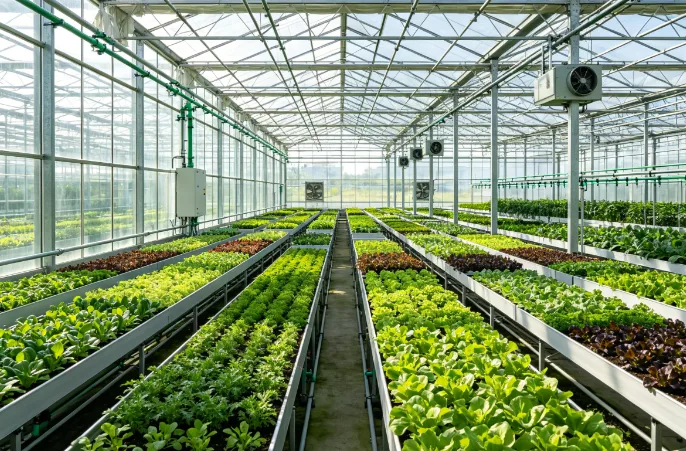
Covering materials directly influence light transmission and thermal insulation. Research from University of California Agriculture and Natural Resources confirms that optimal light transmission for most crops ranges between 70% and 90%.
| Material | Light Transmission | Insulation | Lifespan |
|---|---|---|---|
| Glass | 90% | Low | 25+ yrs |
| Polycarbonate | 75–85% | High | 10–15 yrs |
| Polyethylene Film | 80–90% | Medium | 2–5 yrs |
Diffused light improves canopy penetration and reduces plant stress. Many commercial growers adopt polycarbonate greenhouse panels for balanced efficiency and durability.
Climate Control Systems for Yield Optimization
Climate control systems regulate internal greenhouse conditions to maintain optimal plant growth. The National Renewable Energy Laboratory reports that automated climate systems can reduce energy consumption by up to 30%.
Key components include:
- Ventilation systems (natural and forced airflow)
- Heating systems (boilers, radiant heating)
- Cooling systems (evaporative cooling, fogging)
- CO₂ enrichment systems
Integrated climate control ensures stable temperature ranges, typically between 18°C and 30°C depending on crop type. Advanced systems paired with greenhouse climate control systems significantly enhance productivity.
Irrigation and Fertigation Systems in Greenhouse Production
Irrigation systems deliver water and nutrients with precision. Drip irrigation is the most widely used method due to efficiency and reduced water waste. The United States Geological Survey states that drip irrigation can reduce water usage by up to 50% compared to traditional methods.
| System Type | Water Efficiency | Control Level | Suitability |
|---|---|---|---|
| Drip Irrigation | High | High | Most greenhouse crops |
| Ebb and Flow | Medium | Medium | Hydroponic systems |
| Sprinkler | Low | Low | Limited applications |
Fertigation integrates nutrient delivery into irrigation systems, improving nutrient uptake efficiency. Systems such as greenhouse drip irrigation kits support precise crop management.
Ventilation and Airflow Design for Plant Health
Ventilation design ensures adequate air exchange and humidity control. Poor airflow increases disease risk and reduces transpiration efficiency. The Cornell University College of Agriculture and Life Sciences emphasizes that proper ventilation reduces fungal disease incidence significantly.
Ventilation strategies include:
- Roof vents for natural convection
- Side vents for cross-ventilation
- Mechanical fans for controlled airflow
Air circulation maintains uniform temperature distribution across the greenhouse. Implementing greenhouse ventilation systems ensures consistent internal conditions.
Automation and Smart Greenhouse Technologies
Automation enhances precision and reduces labor dependency. Smart greenhouse systems integrate sensors, data analytics, and control software to manage environmental parameters. According to the European Commission, digital agriculture technologies can increase productivity by 25% while reducing resource consumption.
Automation components include:
- Environmental sensors (temperature, humidity, CO₂)
- Automated irrigation controllers
- Climate control software
Smart systems enable real-time monitoring and predictive adjustments. Integrating smart greenhouse automation systems improves operational efficiency and crop consistency.
Energy Efficiency Strategies in Commercial Greenhouses
Energy consumption is a major operational cost in greenhouse production. Heating alone can account for up to 70% of energy use in cold climates, according to the International Energy Agency.
Energy-saving strategies include:
- Thermal screens to reduce heat loss
- Double-layer coverings for insulation
- Renewable energy integration (solar panels, geothermal)
Energy-efficient design reduces operational cost and environmental impact. Combining insulation materials with optimized systems enhances long-term profitability.
Key Design Checklist for Maximum Crop Yield
A structured greenhouse design process ensures consistent performance:
- Define crop-specific environmental requirements
- Select appropriate structure and covering materials
- Design efficient climate control and irrigation systems
- Integrate automation for monitoring and control
- Optimize energy consumption through insulation and renewable sources
This checklist aligns greenhouse design decisions with measurable agricultural outcomes.
FAQ: Commercial Greenhouse Design and Optimization
1. What defines a commercial greenhouse system?
A commercial greenhouse system is a controlled agricultural environment designed for large-scale crop production. The system integrates structural design, climate control, irrigation, and automation to achieve consistent yield and quality across multiple growing cycles.
2. How does greenhouse orientation affect crop yield?
Orientation influences sunlight exposure and energy efficiency. East–west alignment improves winter light capture in higher latitudes, while north–south orientation provides uniform light distribution in lower latitudes. Proper alignment reduces reliance on artificial lighting.
3. What is the role of CO₂ enrichment in greenhouses?
CO₂ enrichment increases photosynthesis efficiency when light and temperature are optimal. Controlled CO₂ levels, typically between 800–1,200 ppm, can significantly enhance plant growth rates and overall productivity in enclosed environments.
4. How to choose between natural and mechanical ventilation?
Natural ventilation relies on wind and temperature differences, suitable for mild climates. Mechanical ventilation uses fans and controls for precise airflow, ideal for intensive production systems requiring stable environmental conditions.
5. What are common mistakes in greenhouse design?
Common errors include underestimating ventilation requirements, selecting inappropriate covering materials, and ignoring energy efficiency. Poor system integration often leads to uneven climate conditions, increasing disease risk and reducing crop yield stability.