
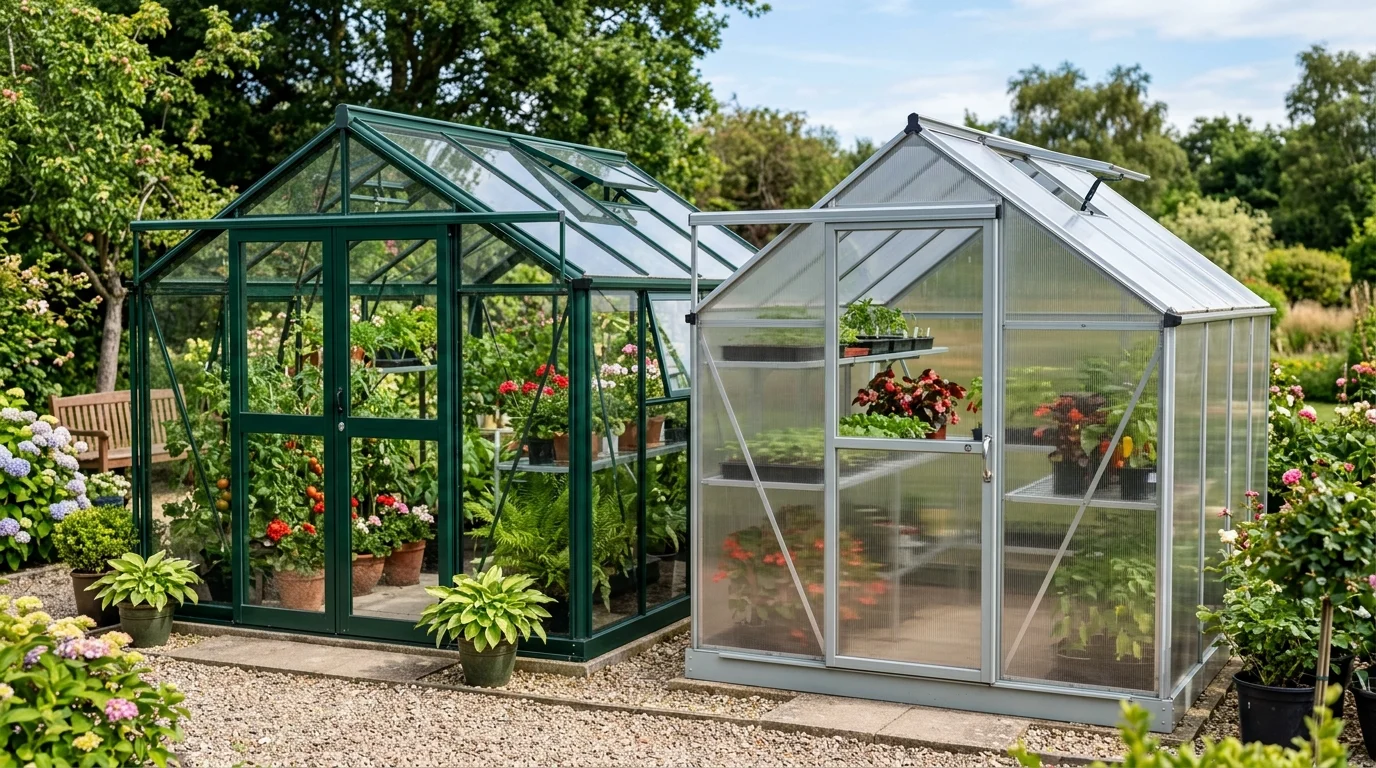
Introduction
Choosing between glass and polycarbonate affects far more than appearance: it shapes light transmission, insulation, durability, maintenance demands, and total project cost over the life of a greenhouse. For growers, investors, and facility planners, the right material depends on crop requirements, local climate, production goals, and budget tolerance. This comparison explains where each option performs best, how the trade-offs influence both capital and operating costs, and which factors matter most before making a final specification. With that framework in place, the rest of the article breaks down the practical differences that determine which greenhouse type is the better fit.
Why choose between a glass greenhouse and a polycarbonate greenhouse
Selecting the optimal glazing material is one of the most consequential decisions in commercial agricultural development. The choice between a glass greenhouse and a polycarbonate greenhouse fundamentally dictates the facility’s upfront capital expenditure (CapEx), long-term operational costs (OpEx), and overall agronomic potential. While structural frames can be adapted or reinforced, the glazing material serves as the permanent barrier between the external climate and the controlled indoor environment.
Industry data indicates that structural and glazing materials account for 15% to 25% of a commercial facility’s total build cost. With fully equipped glass facilities often ranging from $25 to $50 per square foot and polycarbonate structures typically costing between $15 and $30 per square foot, decision-makers must rigorously evaluate their operational priorities before committing to a specific greenhouse solution.
How do crop strategy, climate, and operating model affect the choice
The intended crop serves as the primary driver for material selection. High-wire crops, such as vine tomatoes and cucumbers, operate on a strict light-to-yield ratio where a 1% increase in photosynthetically active radiation (PAR) generally yields a 1% increase in production. For these light-intensive crops, the superior light transmission of glass is often non-negotiable. Conversely, leafy greens, cannabis, and ornamental crops may thrive under the slightly diffused, lower-intensity light provided by polycarbonate panels.
Climate and the operating model further complicate the decision. A facility located in a region with severe, prolonged winters may prioritize the thermal retention properties of multi-wall polycarbonate to suppress heating costs. Conversely, operators in temperate or high-latitude regions often rely on glass to maximize solar heat gain and natural light penetration during abbreviated winter days.
Which business metrics should decision-makers prioritize
When evaluating glazing options, executive teams must analyze multiple business metrics beyond initial procurement costs. The payback period (ROI) is a critical threshold; polycarbonate structures often achieve ROI within 3 to 5 years due to lower CapEx, making them attractive for fast-to-market ventures. Glass structures typically require a 7 to 10-year ROI horizon but offer a significantly longer asset lifespan.
Energy efficiency metrics, specifically the cost per square meter for heating and cooling, must be modeled against local utility rates. Furthermore, depreciation schedules and the anticipated cost of replacing polycarbonate panels every 10 to 15 years must be factored into the 20-year financial forecast to accurately compare the total cost of ownership against a permanent glass structure.
What are the core material and structural differences
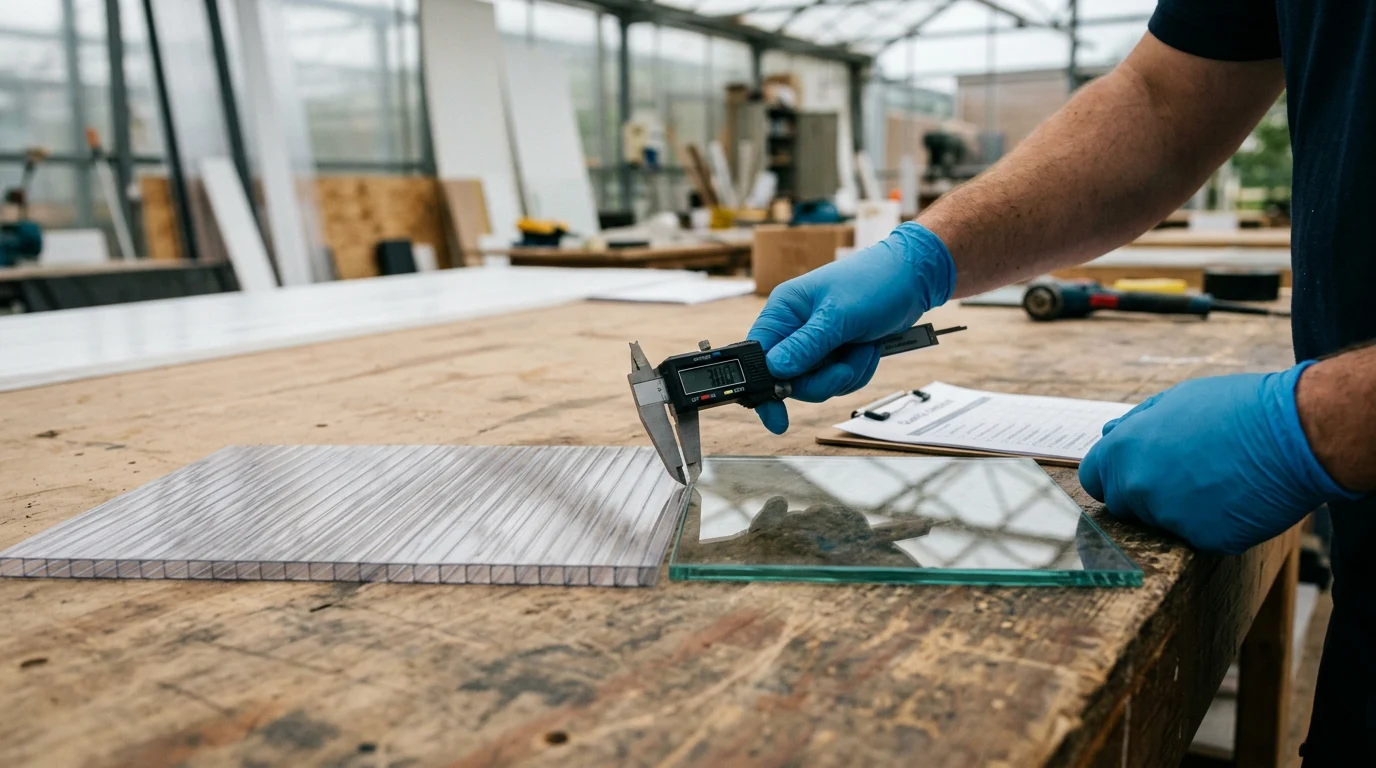
The physical properties of glass and polycarbonate dictate entirely different structural engineering approaches. Because the glazing material must withstand environmental stresses while supporting its own mass, the underlying framework of the greenhouse is intrinsically linked to the chosen covering.
How is a glass greenhouse specified
Modern horticultural glass is heavily engineered. The standard specification is 4mm tempered glass, which provides roughly four to five times the impact resistance of standard annealed glass. To optimize light scattering and prevent canopy shading, roof panes frequently feature a diffuse treatment combined with anti-reflective (AR) coatings, pushing light transmission up to 96%.
Structurally, glass is exceptionally heavy. A 4mm pane weighs approximately 2.0 to 2.5 pounds per square foot. This mass requires a robust, high-tensile steel or heavy-duty aluminum framework to prevent structural sagging and ensure the rigid panes do not crack under load. The framing relies on precision-extruded glazing bars and specialized rubber or EPDM gaskets to maintain a watertight seal without placing mechanical stress on the glass edges.
How is a polycarbonate greenhouse specified
Polycarbonate is a thermoplastic polymer characterized by its high impact resistance and lightweight nature. Commercial greenhouses typically utilize multi-wall polycarbonate—most commonly 8mm twin-wall or 16mm triple-wall configurations. An 8mm twin-wall polycarbonate panel weighs approximately 0.35 pounds per square foot, which is roughly 85% lighter than a standard 4mm glass pane.
This lightweight profile allows for wider purlin spacing and lighter structural steel components, reducing the overall tonnage of metal required for the build. Polycarbonate panels are extruded with a UV-resistant layer on the exterior surface to mitigate the rapid degradation caused by solar radiation. Unlike rigid glass, polycarbonate is flexible and can be cold-formed over curved roof profiles, making it highly adaptable for gothic arch or quonset-style structures.
| Specification | 4mm Tempered Glass | 8mm Twin-Wall Polycarbonate |
|---|---|---|
| Weight (lbs/sq ft) | 2.0 – 2.5 | ~ 0.35 |
| Light Transmission | 90% – 96% | 80% – 84% |
| Flexibility | Rigid / Zero bend | High / Cold-formable |
| Standard Lifespan | 30 – 50+ years | 10 – 15 years |
How do glass and polycarbonate greenhouse performance compare
Performance comparisons between these two materials hinge on a fundamental trade-off: maximizing light penetration versus maximizing thermal insulation. Over the lifecycle of a commercial facility, these performance metrics directly influence crop yields, utility bills, and maintenance schedules.
Which factors matter most in thermal efficiency and light quality
Thermal efficiency is measured by the U-value (heat loss rate); a lower U-value indicates superior insulation. Standard 4mm single-layer glass has a U-value of approximately 1.1 (R-value of 0.9), meaning it offers minimal resistance to heat transfer. In contrast, 8mm twin-wall polycarbonate traps air between its flutes, achieving a U-value of roughly 0.58 (R-value of 1.7). In freezing climates, this insulation gap is substantial.
However, light quality heavily favors glass. While polycarbonate starts with an 80% to 84% transmission rate, the polymer degrades under UV exposure, losing approximately 1% of its light transmission capacity annually. Glass is chemically inert; its light transmission remains virtually unchanged over decades, ensuring consistent crop yields year after year.
How do maintenance and replacement cycles differ
Maintenance routines and lifecycle timelines diverge significantly between the two materials. Glass is highly resistant to scratching and chemical degradation. It can be aggressively cleaned using automated roof-washing robots and standard horticultural detergents. A well-maintained glass greenhouse will easily exceed a 30-year operational lifespan.
Polycarbonate requires a more delicate maintenance approach. Abrasive brushes or harsh chemicals can strip the protective UV coating, accelerating yellowing and brittleness. Furthermore, the internal flutes of multi-wall polycarbonate can trap condensation, algae, or dust if the edge sealing tape fails. Due to UV degradation and micro-abrasions, polycarbonate panels generally require full replacement every 10 to 15 years, necessitating periodic capital injections.
What are the main upfront and operating cost drivers
The upfront CapEx for a glass greenhouse is typically 30% to 40% higher than an equivalent polycarbonate structure, driven by the cost of the tempered glass, the heavier steel framework, and the specialized labor required for installation. Operating costs (OpEx), however, tell a different story.
Operators of polycarbonate greenhouses in cold climates often realize a 20% to 30% reduction in winter heating costs compared to single-pane glass facilities. Conversely, glass operators benefit from higher gross revenues due to maximized crop yields and avoid the massive labor and material costs associated with decadal roof replacements. Examining long-term commercial showcases reveals that the optimal financial choice depends entirely on the specific climate zone and crop margin.
What sourcing, compliance, and installation factors matter
Procuring and erecting a commercial greenhouse involves complex supply chain management and strict adherence to local engineering standards. The physical differences between glass and polycarbonate create distinct logistical pathways and installation requirements that project managers must anticipate.
How do building codes and wind and snow loads affect selection
Commercial greenhouses are classified as permanent structures and must comply with regional building codes (such as ASCE 7-16 in the United States or Eurocode 1 in Europe). Glass structures, being rigid and heavy, demand highly precise engineering to withstand localized wind loads (often specified at 115 to 120+ mph) and snow loads (30+ psf). If the steel frame flexes excessively under wind pressure, glass panes will shatter.
Polycarbonate structures are inherently more forgiving of frame deflection. However, lightweight polycarbonate panels are highly susceptible to wind uplift. Fastening systems must be engineered with specific washer sizes and spacing to prevent the panels from tearing away from the purlins during severe weather events. Local municipalities may also evaluate the fire ratings of the materials; glass is non-combustible, whereas polycarbonate is a combustible plastic that must meet specific flame-spread indices (e.g., ASTM E84 Class A).
What logistics, packaging, lead times, and breakage risks should buyers assess
Logistics and supply chain risks vary dramatically. Horticultural glass, particularly specialized diffuse glass with AR coatings, is often manufactured in Europe or Asia. Lead times can stretch from 12 to 16 weeks. Glass is shipped in heavy A-frame crates, and buyers must typically accept a 2% to 4% breakage allowance during international transit, requiring over-ordering to ensure sufficient site inventory.
Polycarbonate panels are generally easier and cheaper to transport. They can be sourced from regional extruders, reducing lead times to 4 to 8 weeks. Panels are shipped flat on standard pallets or rolled if using corrugated single-wall profiles. Breakage during transit is exceedingly rare, simplifying inventory management and reducing shipping insurance premiums.
Which installation capabilities are most critical
Installation capabilities often dictate project timelines. Glazing a glass greenhouse requires specialized crews equipped with vacuum lifters, scissor lifts, and scaffolding. The process is labor-intensive and highly sensitive to weather conditions; glass cannot be safely installed during high winds. The aluminum capping and rubber gasket systems demand millimeter precision.
Polycarbonate installation is significantly faster and requires less specialized heavy machinery. Panels can be cut to size on-site using standard power tools, allowing crews to adapt to minor framing discrepancies immediately. This ease of handling often translates to lower labor costs and faster project commissioning, which is vital for operators racing to meet a specific planting season.
How should buyers choose between glass and polycarbonate
Ultimately, the decision between glass and polycarbonate is not about identifying a universally superior material, but rather aligning the greenhouse’s physical characteristics with the grower’s agronomic goals, climatic realities, and financial constraints.
When is glass the stronger option
Glass is the definitive choice for long-term, legacy agricultural investments spanning 20 to 50 years. It is the stronger option for high-DLI (Daily Light Integral) crops where maximum light transmission directly correlates to revenue. Glass is also preferred in high-humidity environments where condensation control is critical; specialized coatings on glass allow condensation to sheet down the pane into gutters rather than dripping onto the canopy, thereby reducing fungal disease vectors.
Additionally, facilities relying on high levels of automation—such as robotic harvesters and automated climate control algorithms—benefit from the stable, predictable light transmission and rigid structural integrity that a glass environment provides.
When is polycarbonate the better fit
Polycarbonate is the better fit for projects prioritizing rapid deployment and lower initial capital outlay. It excels in harsh winter climates where the thermal insulation of multi-wall panels drastically reduces fossil fuel consumption.
Furthermore, in geographic zones prone to severe hail storms, polycarbonate offers unparalleled security. High-quality polycarbonate features up to 200 times the impact resistance of standard glass, protecting the crop from catastrophic weather events that could shatter even tempered glass roofs.
What decision framework helps compare site conditions and goals
To navigate this choice, agricultural executives should utilize a weighted decision framework that evaluates site-specific variables against corporate goals. Key inputs should include a 10-year energy cost projection, localized weather extremes (hail, snow, wind), and the specific light requirements of the target cultivar. When evaluating these variables, partnering with specialists can help accurately model the long-term financial outcomes of each material.
| Decision Factor | Glass Greenhouse Advantage | Polycarbonate Greenhouse Advantage |
|---|---|---|
| Light Transmission | Maximum PAR, zero long-term degradation | Moderate PAR, diffuses direct sunlight |
| Thermal Efficiency | Poor (Single-layer U-value ~1.1) | High (Multi-wall U-value ~0.58) |
Further reading:
Key Takeaways
- The most important conclusions and rationale for glass greenhouse vs polycarbonate greenhouse
- Specs, compliance, and risk checks worth validating before you commit
- Practical next steps and caveats readers can apply immediately
Frequently Asked Questions
Which greenhouse glazing is cheaper upfront?
Polycarbonate usually has lower upfront cost, often around $15–$30 per square foot versus $25–$50 for glass in commercial builds.
Which option gives better light for high-yield crops?
Glass generally delivers higher light transmission, especially with diffuse AR-coated panels, making it better for tomatoes, cucumbers, and other light-driven crops.
Is polycarbonate better for cold climates?
Often yes. Multi-wall polycarbonate provides better insulation, which can reduce heating demand in regions with long, severe winters.
How long do glass and polycarbonate coverings typically last?
Glass is typically the longer-life option, while polycarbonate panels often need replacement after about 10–15 years depending on exposure and grade.
Where can I compare commercial greenhouse solutions in more detail?
You can review commercial greenhouse examples and product options on MiilkiiA Blog at miilkiiablog.com/showcases and miilkiiablog.com/product-category/product/.