
Introduction
In a greenhouse, excess heat and humidity can build quickly, pushing crops beyond the conditions they need for steady growth. Cooling systems do more than make the space comfortable—they help maintain stable temperature and moisture levels that support photosynthesis, nutrient uptake, pollination, and disease control. This article explains how greenhouse cooling systems work, why they matter for plant health, and how they help reduce stress, prevent quality losses, and improve overall yield in commercial growing environments.
Why Greenhouse Cooling Systems Matter for Crop Growth
Commercial agricultural operations face an ongoing battle against volatile external climates. In enclosed growing environments, solar radiation and plant transpiration rapidly accumulate heat and moisture, quickly exceeding optimal thresholds. Implementing robust greenhouse cooling systems is a fundamental requirement for commercial viability, as these technologies directly dictate the physiological performance and marketable output of cultivated crops.
How cooling systems stabilize temperature and humidity
At their core, environmental control mechanisms manipulate the internal atmosphere by managing the complex interplay between sensible and latent heat. During peak solar radiation, internal greenhouse temperatures can easily exceed outside ambient temperatures by 10°C to 15°C without active intervention. Cooling infrastructure actively stabilizes this environment by exhausting trapped hot air and introducing conditioned air, maintaining the ambient temperature within the typical optimal vegetative range of 20°C to 28°C. Simultaneously, these mechanisms regulate relative humidity, preventing the extreme moisture accumulation that naturally results from dense plant canopies transpiring in an enclosed space.
Which crop risks, yield losses, and quality defects cooling helps prevent
Failure to maintain strict climate parameters exposes commercial crops to severe physiological and pathological risks. When temperatures surpass 32°C, many fruiting crops, such as tomatoes and peppers, experience rapid pollen degradation, leading to blossom drop and total fruit abortion. In leafy greens, excessive heat combined with poor transpiration rates restricts calcium mobility, causing costly tip burn defects. Furthermore, if relative humidity lingers above 85% due to inadequate air exchange, the environment becomes a highly favorable vector for destructive fungal pathogens like Botrytis cinerea and powdery mildew. Effective cooling mitigates these specific threats, preserving both the volume and the aesthetic grade of the harvest.
Types of Greenhouse Cooling Systems for Different Crops
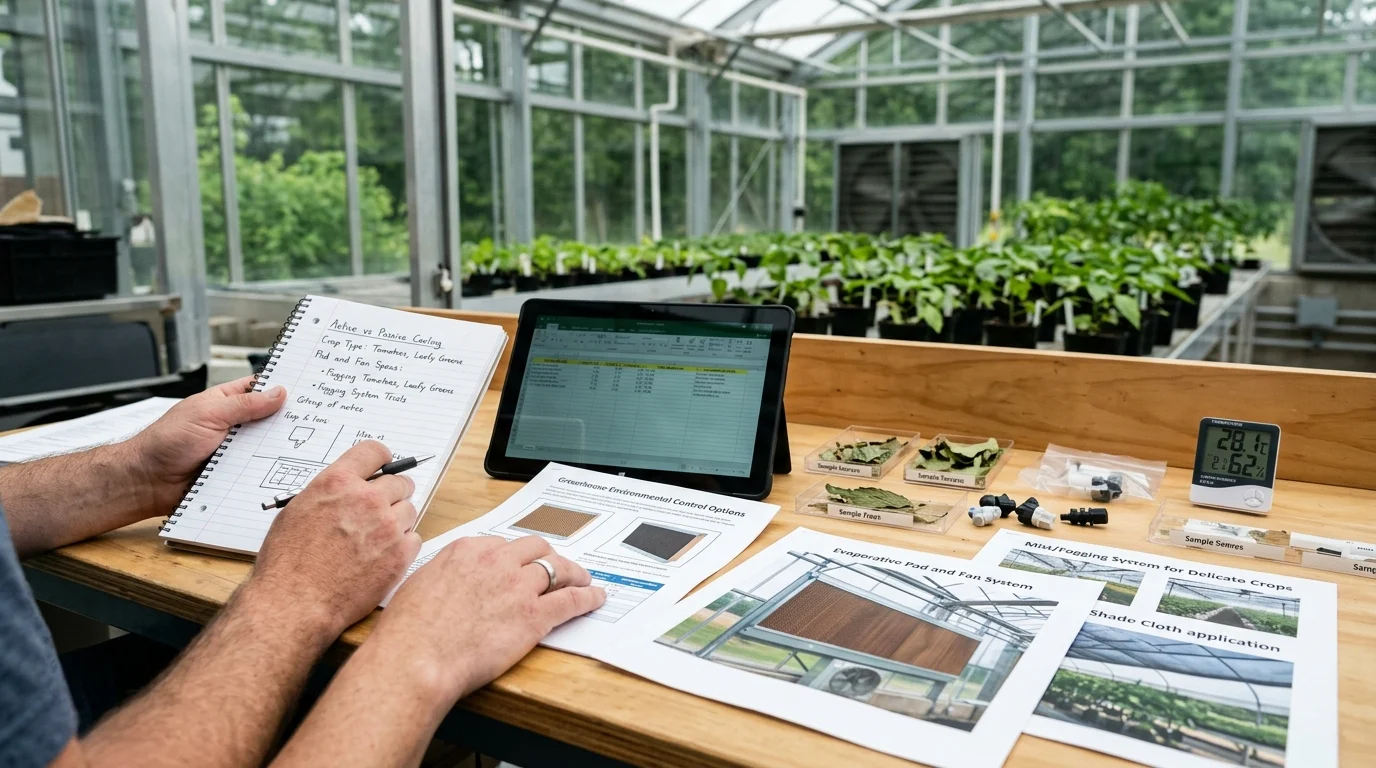
No single climate control solution applies universally to all agricultural environments. The selection of cooling infrastructure depends heavily on the interplay between the facility’s structural design, the external geographic climate, and the specific physiological demands of the cultivated crop.
How evaporative cooling, fan-and-pad systems, fogging, and natural ventilation compare
The commercial sector relies on a spectrum of active and passive technologies. Natural ventilation utilizes strategically placed ridge and side vents to exhaust warm air through thermal buoyancy, offering a low-energy baseline but limited temperature reduction. Fan-and-pad systems utilize evaporative cooling by pulling outside air through a wetted cellulose pad; depending on external humidity, this can drop incoming air temperatures by 8°C to 12°C. High-pressure fogging systems inject micro-droplets (typically 10 to 15 microns in diameter) into the air at pressures exceeding 1,000 PSI. These droplets flash-evaporate, absorbing latent heat from the air without wetting the plant canopy, providing highly uniform cooling and precise humidity control.
Which comparison criteria matter most when evaluating cooling systems
When evaluating these technologies, facility managers must weigh multiple operational metrics against their production goals.
| System Type | Typical Temp Reduction | Initial Capital Cost | Water Consumption | Ideal Climate Profile |
|---|---|---|---|---|
| Natural Ventilation | 0°C to 2°C (matches ambient) | Low | None | Mild, predictable wind patterns |
| Fan-and-Pad Evaporative | 8°C to 12°C | Moderate | High | Hot and arid (low humidity) |
| High-Pressure Fogging | 5°C to 10°C | High | Moderate | Hot and arid to moderately humid |
| Mechanical HVAC (Chillers) | Precise control | Very High | Low (condensate recovery) | Sealed environments / high-value crops |
How to match cooling systems to crop and climate needs
The efficacy of any evaporative method is strictly governed by the external wet-bulb temperature. In arid regions where ambient relative humidity frequently drops below 40%, fan-and-pad or fogging systems operate at peak efficiency, maximizing the evaporative cooling effect. Conversely, in tropical or highly humid coastal climates where ambient humidity consistently exceeds 70%, the air’s capacity to absorb additional moisture is severely limited. In these humid zones, growers must prioritize high-volume air exchange through robust exhaust fans and natural ventilation, or invest in mechanical dehumidification and chilling systems to achieve the necessary climate targets.
How Cooling Systems Improve Yield, Quality, and Plant Health
The primary objective of agricultural climate control extends beyond mere temperature reduction; it focuses on optimizing the microclimate directly surrounding the plant canopy. By actively managing this zone, commercial growers can unlock the full genetic potential of their crops, translating environmental stability into direct economic gains.
How tighter climate control supports growth and reduces stress
Plant growth is primarily driven by photosynthesis and transpiration, both of which are highly sensitive to environmental fluctuations. Tighter climate control allows growers to maintain an ideal Vapor Pressure Deficit (VPD), typically targeted between 0.8 and 1.2 kPa for most greenhouse vegetables. When VPD is maintained within this narrow band, stomatal conductance is optimized. The plant’s stomata remain open, facilitating maximum carbon dioxide uptake for photosynthesis while maintaining a steady flow of water and nutrients from the root zone to the upper foliage. By preventing the extreme stress of high temperatures or severely low humidity, the plant redirects metabolic energy away from survival mechanisms and into active cellular growth and fruit development.
What measurable gains cooling systems can deliver in yield and quality
The implementation of precise cooling infrastructure yields highly quantifiable improvements in agricultural output. In commercial cucumber and tomato operations, maintaining temperature and VPD within strict optimal thresholds has been shown to increase overall fruit yield by 15% to 20% compared to passively cooled structures subject to mid-day heat spikes. Beyond raw tonnage, the uniformity and grade of the produce improve dramatically. Consistent temperatures prevent irregular fruit expansion, cracking, and physiological disorders, ensuring a higher percentage of the harvest meets premium retail specifications. Documented showcases of modernized facilities frequently highlight these exact improvements in pack-out rates and overall crop vigor.
Technical and Operational Factors to Review Before Buying
Transitioning from agronomic theory to facility engineering requires a rigorous assessment of technical specifications and operational constraints. Purchasing and integrating a cooling system is a complex capital investment that mandates careful scrutiny of the facility’s existing infrastructure and long-term resource availability.
Which system specifications matter most
The foundational metric for any active ventilation and cooling design is the air exchange rate, typically measured in cubic feet per minute (CFM) or cubic meters per hour. A standard commercial specification requires the system to perform one complete air exchange per minute up to a height of 8 to 10 feet. This generally translates to an airflow requirement of approximately 8 CFM per square foot of greenhouse floor space. Additionally, static pressure—the resistance to airflow caused by insect screens, wet pads, and crop canopies—must be accurately calculated. Exhaust fans must be rated to deliver the required CFM at the specific static pressure of the facility, often around 0.10 to 0.15 inches of water column, to ensure the system does not underperform during peak summer loads.
How energy use, water supply, sanitation, and maintenance affect performance
Resource consumption and maintenance logistics are critical variables in the operational success of cooling technologies. Evaporative cooling and fogging systems demand substantial water supplies; more importantly, they require specific water quality. High-pressure fogging nozzles are highly susceptible to scaling and clogging if the water’s electrical conductivity (EC) exceeds 1.0 mS/cm or if calcium carbonate levels are high, often necessitating the installation of reverse osmosis (RO) filtration. Electrically, large-scale exhaust fans and high-pressure pumps require robust three-phase power infrastructure. Maintenance protocols, such as monthly descaling of evaporative pads and routine pump oil changes, must be factored into standard operating procedures to prevent mid-season catastrophic failures.
What steps help compare suppliers and validate system fit
Procuring the right equipment requires systematic vetting of manufacturers and integration partners.
| Evaluation Factor | Key Metric / Specification | Operational Impact |
|---|---|---|
| Fan Efficiency | CFM per Watt ratio | Directly dictates monthly electrical operating costs |
| Pad Material | Flute angle and thickness (e.g., 6-inch) | Determines the balance between cooling efficiency and static pressure |
| Pump Redundancy | Variable Frequency Drive (VFD) capability | Ensures continuous operation and energy savings during partial loads |
| Supplier Support | Parts availability and warranty terms | Minimizes downtime during critical summer harvest windows |
Operators should review detailed technical data sheets and partner with us or other certified distributors to validate that the proposed system architecture aligns perfectly with the facility’s structural load limits and local utility capacities.
How to Choose a Greenhouse Cooling System for Long-Term Value
Finalizing the selection of climate control infrastructure demands a strategic balance between immediate financial constraints and long-term operational resilience. The most effective system is one that aligns seamlessly with the specific economic model of the agricultural enterprise.
Which trade-offs matter most in cost, resilience, and scalability
Capital expenditure (CapEx) and operational expenditure (OpEx) must be evaluated over a projected 10-year lifecycle. Traditional fan-and-pad systems typically present a lower CapEx barrier, often ranging from $2.00 to $4.00 per square foot of greenhouse space, but incur higher ongoing OpEx due to the continuous electrical demand of high-volume exhaust fans. Conversely, high-pressure fogging systems require a steeper initial investment—frequently between $5.00 and $8.00 per square foot due to the specialized pumps and stainless-steel lines—but can offer superior scalability and lower electrical consumption if integrated with natural ventilation. System resilience is also paramount; operations in extreme heat zones must consider redundant pump systems and backup generators, as a cooling failure lasting just a few hours can result in total crop loss.
How to make a final decision based on crop, budget, and operating conditions
The ultimate decision rests on a holistic analysis of the crop’s market value, the geographical climate realities, and the available budget. High-value crops, such as medicinal plants or premium vine crops, easily justify the higher capital outlay for precision fogging or mechanical chilling due to the severe financial penalty of minor quality defects. Conversely, standard nursery stock or hardy ornamentals may only require the cost-effective baseline of fan-and-pad evaporative cooling. By cross-referencing historical local weather data—specifically maximum summer wet-bulb temperatures—with the crop’s physiological limits, agricultural enterprises can deploy a cooling strategy that maximizes yield stability and ensures a robust return on investment.
Further reading:
Key Takeaways
- The most important conclusions and rationale for greenhouse cooling systems
- Specs, compliance, and risk checks worth validating before you commit
- Practical next steps and caveats readers can apply immediately
Frequently Asked Questions
Why are greenhouse cooling systems important for crop growth?
They keep temperature near 20°C to 28°C and prevent excess humidity, helping plants maintain photosynthesis, pollination, and steady growth.
Which greenhouse cooling system works best in hot, dry climates?
Fan-and-pad or high-pressure fogging usually perform best in arid areas, often reducing air temperature by about 5°C to 12°C.
What crop problems can poor greenhouse cooling cause?
Overheating can trigger blossom drop in tomatoes and peppers, tip burn in leafy greens, and higher disease pressure from Botrytis and powdery mildew.
How do I choose between ventilation, evaporative cooling, and HVAC?
Match the system to local humidity, crop value, and greenhouse design. Dry climates suit evaporative cooling; humid regions often need stronger ventilation or HVAC.
Where can I compare greenhouse cooling system options on MiilkiiA Blog?
Visit miilkiiablog.com/product-category/systems/ to review system types and compare cooling approaches for different greenhouse conditions.