
Introduction
Choosing a hydroponic system for commercial lettuce is less about finding a universally “best” option and more about matching technology to production goals, labor strategy, and facility constraints. The right setup can improve yield per square meter, reduce handling time, and simplify cleaning and harvesting, while the wrong one can lock a business into avoidable costs. This article compares the main commercial hydroponic systems used for lettuce production, with attention to space efficiency, labor demands, scalability, and operating complexity, so you can identify which approach best fits your greenhouse model and profit targets.
Why Hydroponic System Choice Matters for Lettuce Profitability
Selecting the optimal infrastructure for commercial lettuce production is a foundational decision that dictates long-term profitability. With commercial greenhouse margins often running tight, operators must maximize output per square meter while strictly controlling overhead. Advanced hydroponic methods allow commercial lettuce yields to reach 10 to 15 times higher per square meter than traditional soil-based farming, but realizing these gains requires precise alignment between the chosen system and the facility’s operational model.
Yield, Labor, and Space Efficiency
Yield, labor, and space efficiency act as the primary drivers of unit economics. Labor alone typically accounts for 40% to 50% of total operating expenses (OPEX) in controlled environment agriculture. Systems that streamline transplanting, harvesting, and cleaning drastically reduce these recurring costs. Space utilization also varies significantly; while horizontal pond systems maximize a single-level footprint, channel-based systems allow for vertical stacking, potentially multiplying yield per square meter of facility floor space by a factor of three or four, depending on ceiling height.
Production Goals and Business Priorities
Commercial operators must define their production goals before committing to infrastructure. A facility targeting living lettuce sales—where the plant is sold with the root ball intact to extend shelf life—requires different handling mechanics than a bulk processing facility focused on chopped, bagged greens. Furthermore, business priorities such as targeting precise 150-gram to 200-gram head weights within strict 35-day to 40-day crop cycles dictate the nutrient delivery precision and environmental controls required from the system.
Best Hydroponic Systems for Commercial Lettuce
The industry standardizes around a few proven methodologies for cultivating leafy greens at scale. When evaluating commercial hydroponic systems, operators predominantly choose between two dominant architectures, with niche applications reserved for alternative methods.
| System Feature | Nutrient Film Technique (NFT) | Deep Water Culture (DWC) |
|---|---|---|
| Water Volume per Plant | Low (< 0.5 Liters) | High (3 – 5 Liters) |
| Thermal Buffering | Poor | Excellent |
| Vertical Scalability | High (Multi-tier capable) | Low (Single-tier standard) |
| Root Harvesting | Intact / Clean | Tangled / Requires trimming |
Nutrient Film Technique
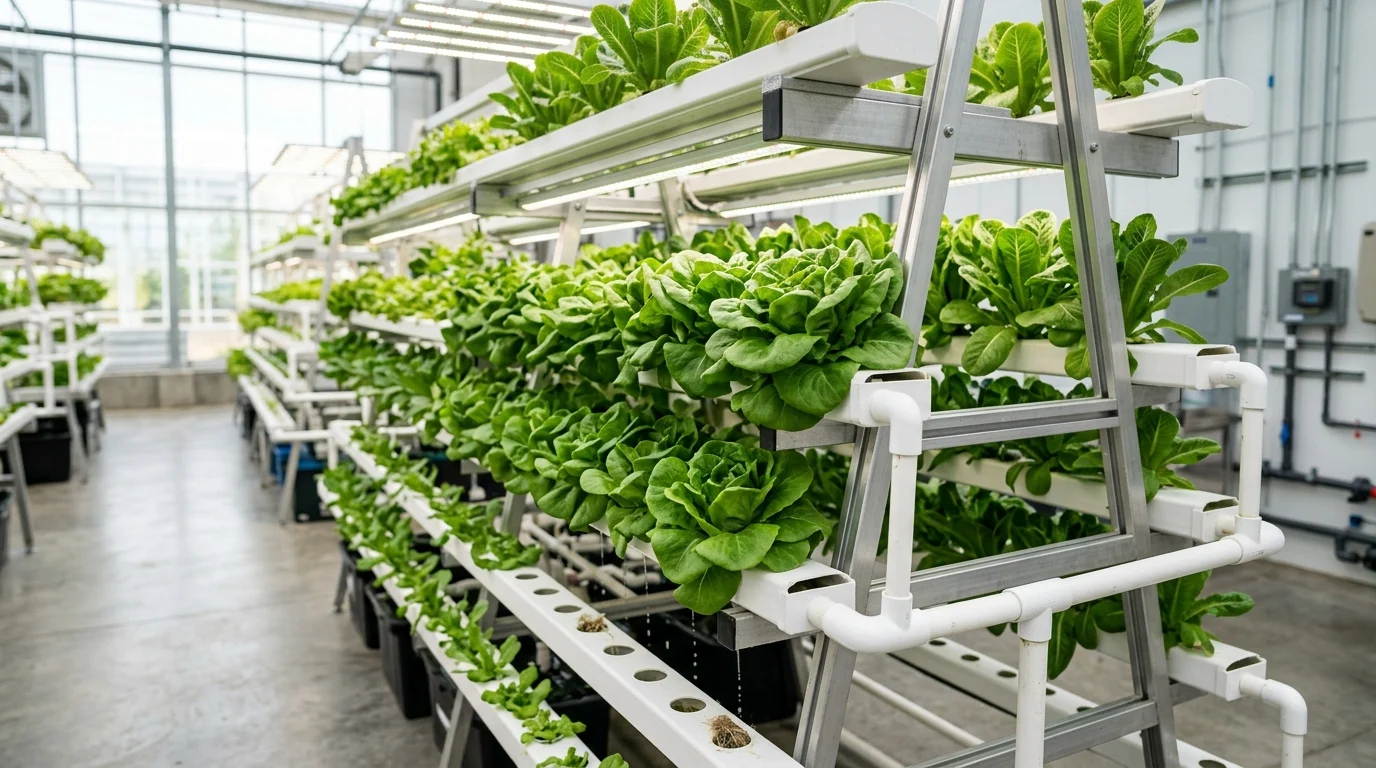
The Nutrient Film Technique (NFT) utilizes shallow PVC or food-grade plastic channels where a continuous, thin film of nutrient solution flows over the plant roots. Commercial NFT channels are typically installed at a 1% to 2% slope to ensure gravity-assisted drainage, requiring a highly regulated flow rate of 1 to 2 liters per minute. This shallow stream ensures excellent oxygen exchange at the root zone without the need for supplemental aeration devices in the channels themselves. However, the low water volume means the system offers virtually no buffer against pump failures or sudden temperature spikes.
Deep Water Culture
Deep Water Culture (DWC), or raft systems, involves floating extruded polystyrene boards on large, shallow ponds of nutrient solution. These ponds are typically maintained at a depth of 8 to 12 inches. The massive volume of water provides exceptional thermal mass, acting as a buffer that stabilizes root zone temperatures even when ambient greenhouse air fluctuates. Because roots are fully submerged, operators must aggressively oxygenate the ponds using air stones or venturi injectors to maintain Dissolved Oxygen (DO) levels between 6 and 8 mg/L to prevent root asphyxiation and pathogen proliferation.
Media-Based and Other Systems
While NFT and DWC dominate lettuce production, media-based systems (like ebb and flow benches) and aeroponics occasionally appear in specialized setups. Aeroponics, which mists roots in a suspended chamber, can reduce water usage by a further 20% compared to standard hydroponics. However, the reliance on high-pressure pumps and 50-micron to 100-micron spray nozzles introduces severe clogging risks. For a high-volume, low-margin crop like lettuce, the elevated maintenance requirements of these alternative systems generally offset their theoretical yield advantages.
Technical and Operational Factors to Compare
Beyond the physical architecture, successful lettuce cultivation relies on managing the biological and chemical realities of the chosen system. Technical parameters dictate the daily operational workflow and directly influence the financial viability of the farm.
| Parameter | Target Range | Critical Threshold | Primary Corrective Action |
|---|---|---|---|
| pH Level | 5.6 – 6.0 | < 5.2 or > 6.5 | Automated acid/base dosing |
| EC Level | 1.2 – 1.8 mS/cm | > 2.5 mS/cm | Fresh water dilution / Nutrient adjustment |
| Dissolved Oxygen | 6.0 – 8.0 mg/L | < 4.0 mg/L | Increase aeration / lower water temp |
| Water Temp | 68°F – 72°F | > 75°F (24°C) | Activate nutrient chillers |
Water Quality, Oxygenation, and Climate Control
Maintaining precise water chemistry and climate control is non-negotiable. Commercial lettuce thrives when the nutrient solution pH is held strictly between 5.6 and 6.0, with an Electrical Conductivity (EC) ranging from 1.2 to 1.8 mS/cm depending on the specific cultivar and growth stage. DWC systems, with their large thermal mass, make it easier to maintain the ideal root zone temperature of 68°F to 72°F (20°C to 22°C). In contrast, NFT systems require rigorous management of the ambient air temperature and aggressive chilling of the central reservoir, as the shallow nutrient film rapidly absorbs ambient heat in the greenhouse.
Food Safety and Maintenance Risks
Food safety and maintenance protocols differ drastically between systems. NFT channels must be thoroughly cleaned and sanitized between every harvest cycle to prevent biofilm buildup, which demands significant labor. DWC ponds, conversely, are rarely emptied; instead, the rafts are scrubbed and sanitized. The primary biological risk in DWC is the rapid spread of waterborne pathogens like Pythium (root rot) through the shared water volume. Commercial operators mitigate this by integrating commercial-grade UV sterilizers or ozone generators into the central filtration loop, ensuring the entire water volume is treated multiple times per day.
Costs and Return on Investment
Capital expenditures (CAPEX) and long-term return on investment (ROI) form the ultimate deciding factors. Installing commercial NFT infrastructure typically costs between $15 and $25 per square meter for the channels and racking alone, excluding central dosing equipment. DWC ponds require substantial initial earthworks, leveling, and heavy-duty food-grade liners, often costing $10 to $20 per square meter, but they demand significantly higher water and nutrient volumes upfront. When calculating ROI, operators must weigh the higher initial setup costs against the projected lifespan of the equipment and the recurring labor costs of harvesting and sanitization.
How to Evaluate Systems Before Scaling
Transitioning from a conceptual design to a fully operational facility carries substantial financial risk. Before committing millions in capital, operators must validate their assumptions through rigorous testing and supplier vetting. Reviewing real-world commercial hydroponic systems in action can provide a baseline for what is achievable.
Pilot Testing and Performance Benchmarks
Running a pilot test is standard practice for risk mitigation. A scaled-down prototype—typically covering 500 to 1,000 square feet—allows operators to benchmark critical performance metrics under local environmental conditions. During this phase, management should closely track germination rates, growth cycles, and defect rates. For a commercial lettuce operation to remain competitive, the target defect rate must consistently stay below 5%. Any systemic issues with tip burn, bolting, or uneven flow dynamics must be resolved in the pilot phase before expanding the footprint.
Supplier Questions and Support
Vetting equipment suppliers is as critical as selecting the hydroponic method itself. Operators must interrogate vendors regarding equipment durability, replacement part availability, and technical support. For instance, custom PVC channel extrusions for NFT systems often carry Minimum Order Quantities (MOQs) of 5,000 to 10,000 meters. Additionally, supply chain volatility means that specialized pumps or dosing controllers may have lead times stretching from 8 to 12 weeks. Securing guarantees on component availability prevents costly production downtime.
Matching System Design to Market Needs
The physical design of the system must directly serve the demands of the target market. If local distributors demand ‘living lettuce’ packaged with the root ball to extend shelf life, NFT systems are highly advantageous because the roots remain clean and compact. If the market dictates bulk, pre-washed, and chopped spring mix, DWC systems allow for rapid, mechanized harvesting of the canopy where root preservation is irrelevant. Aligning the harvesting mechanics with the final product format ensures no labor is wasted on unnecessary processing.
Choosing the Best System for Your Operation
Ultimately, no single cultivation method reigns supreme across all environments. The decision rests on synthesizing facility constraints, capital availability, and specific market deliverables. Exploring diverse commercial hydroponic systems allows growers to align hardware with their distinct agronomic strategy.
When NFT Is the Best Fit
NFT stands out as the optimal choice for indoor vertical farms or facilities with strict floor load limits. Because the system relies on a thin film of water rather than deep ponds, the total structural weight is remarkably low, averaging less than 15 kg per square meter when fully operational. It is also the superior choice when crop turnaround speed and facility hygiene require completely isolating individual plant rows from one another, minimizing the risk of a single pathogen outbreak destroying an entire greenhouse zone.
When DWC Is the Best Fit
DWC is the undisputed leader for large-scale, single-level greenhouse operations, particularly in regions with high climate variability. The massive water volume—often exceeding 100 liters per square meter—acts as a thermal battery, slashing the energy costs associated with active heating and cooling. For operations producing tens of thousands of heads per week on a continuous 4-week to 6-week cycle, the mechanized handling of floating rafts offers unmatched labor efficiency at scale.
A Simple Decision Framework
Operators should rely on a straightforward decision framework: prioritize NFT if vertical space utilization, living root packaging, and low structural weight are paramount. Prioritize DWC if managing a sprawling, single-level greenhouse where thermal stability and mechanized bulk harvesting drive profitability. By rigorously quantifying labor costs, space constraints, and target yields, commercial growers can confidently select the infrastructure that best secures their competitive advantage in the leafy greens market.
Further reading:
Key Takeaways
- The most important conclusions and rationale for commercial hydroponic systems
- Specs, compliance, and risk checks worth validating before you commit
- Practical next steps and caveats readers can apply immediately
Frequently Asked Questions
Which hydroponic system is usually best for commercial lettuce production?
NFT is often best for high-density, multi-tier lettuce farms. DWC is better when temperature stability and crop buffering matter more than vertical space efficiency.
When should a grower choose NFT over DWC?
Choose NFT if you want vertical stacking, cleaner roots, and easier living lettuce harvests. It fits operations focused on space efficiency and fast handling.
Why do many commercial lettuce farms still use DWC?
DWC offers strong thermal buffering and more stable root conditions. It helps reduce crop stress during temperature swings, but it needs reliable aeration and more floor space.
What operating risk is most critical in an NFT lettuce system?
Pump failure is the biggest risk because NFT has very little water around roots. Use backup pumps, alarms, and regular flow checks to avoid fast crop loss.
Where can I compare commercial lettuce system options in more detail?
You can review commercial hydroponic system layouts and greenhouse solutions on miilkiiablog.com, especially the systems and showcases sections for practical comparisons.