
Determining whether a Container Plant Factory or a traditional greenhouse is more profitable depends on specific operational goals, geographic location, and target crop varieties. A Container Plant Factory offers higher yields per square meter and total environmental isolation, making it ideal for high-value crops in urban or extreme climates. Conversely, a traditional glass greenhouse provides lower operational costs by utilizing natural sunlight, though it remains vulnerable to seasonal fluctuations. Profitability in 2026 is increasingly driven by resource efficiency, with container systems reducing water consumption by 95% and greenhouses offering lower initial capital expenditure (CAPEX). Investors must weigh the high energy demands of indoor LEDs against the climate risks associated with transparent structures.
Comparative Analysis of Containerized Farming and Greenhouse Systems
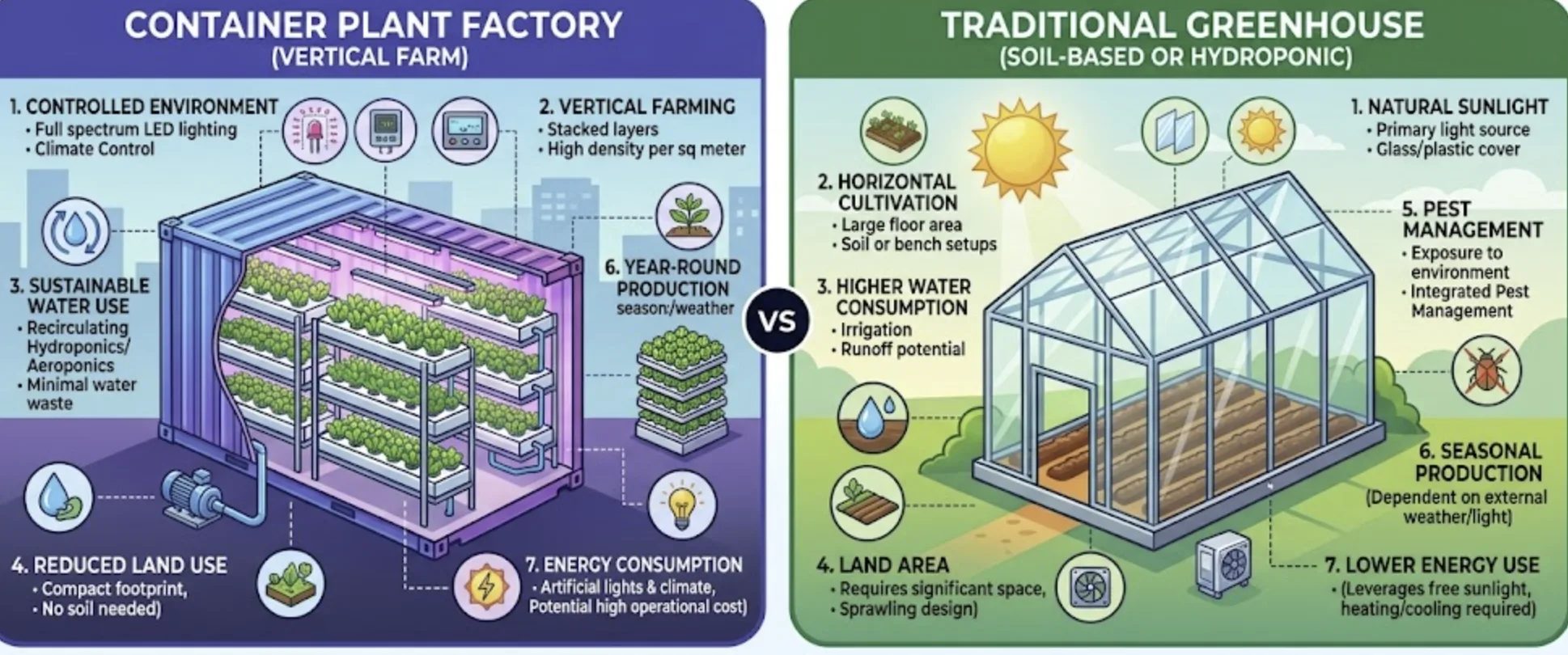
Introduction and Features of the Container Plant Factory
A Container Plant Factory is a fully enclosed, modular agricultural system—typically constructed within standard shipping containers or standalone enclosures—that enables year-round production through the use of LED lighting, hydroponic systems, and fully automated environmental controls.
Key features of the Container Plant Factory
Exclusive use of artificial light sources (LEDs)
Fully enclosed environmental control
Modular and portable design
High-density vertical farming
Advantages:
- Year-round stable production, not affected by seasons or climate conditions
- Extremely high space utilization through multi-layer vertical farming systems
- Suitable for urban agriculture and deployment in extreme environments
- High water efficiency, typically using recirculating hydroponic or aeroponic systems
- Strong standardization and replication capability due to modular container design
Limitations:
- High initial investment cost, including equipment and environmental control systems
- Strong dependence on electricity, especially for LED lighting systems
- Higher operational energy cost per unit compared to conventional systems
- Limited crop variety, mainly suitable for leafy greens and fast-growing crops
Introduction and Features of the Traditional Greenhouse
A Traditional Greenhouse is a semi-enclosed agricultural facility constructed using transparent covering materials (such as glass or plastic film); it relies primarily on natural light while regulating the internal environment through ventilation, shading, and heating systems.
Key features of the Traditional Greenhouse
Primary reliance on natural light
Partial environmental control (temperature and humidity)
Fixed structural design
Predominant use of soil-based or substrate-based cultivation
Advantages:
- Lower energy cost due to reliance on natural sunlight
- Suitable for large-scale agricultural production, including fruits, vegetables, and flowers
- Mature and widely adopted agricultural technology
- Lower cost per unit of production output
- Wider range of cultivable crops compared to controlled indoor systems
Limitations:
- Strongly affected by weather conditions such as temperature and light fluctuations
- Seasonal production limitations in many climate zones
- High dependency on land availability and geographic conditions
- Higher risk of pests and plant diseases
- Lower precision in environmental control compared to fully controlled systems
| Comparison Dimension | Container Plant Factory | Traditional Greenhouse |
|---|---|---|
| Light Source | LED artificial light | Mainly natural sunlight |
| Environmental Control | Fully enclosed & precise control | Semi-open control |
| Construction Form | Modular container unit | Fixed building structure |
| Water Resource Utilization | Recirculating water system (ultra-low loss) | Dependent on irrigation systems |
| Energy Consumption Structure | Electric power driven (high) | Natural light + auxiliary energy (low to medium) |
| Planting Density | High-density vertical planting | Flat or low-layer planting |
| Deployment Speed | Rapid deployment (within weeks) | Long construction cycle (months to years) |
Operational Cost Drivers in Controlled Environment Agriculture
Operating a PC board greenhouse involves managing light transmission and thermal retention, which vary by season. The profitability of these systems is often tied to local climate stability. In regions with harsh winters, heating costs can erode margins. Container plant factories mitigate this by using high-performance insulation, keeping the internal temperature constant regardless of external weather. A study by Wageningen University & Research indicates that while electricity for LEDs accounts for nearly 40% of indoor farming OPEX, the precision of a smart climate control system ensures zero crop loss, providing a “predictable profit” model that banks and insurers increasingly prefer over traditional volatile yields.
Yield Optimization and Market Value of Specialty Crops
The profitability of a Container Plant Factory is maximized when growing “high-margin” crops. While a single-span greenhouse is excellent for seasonal vegetables like peppers or tomatoes, containers excel at producing premium microgreens, edible flowers, and herbs. These crops command higher price points in urban culinary markets. Furthermore, the integration of a hanging strawberry system within container units allows for vertical fruiting layers, effectively tripling the harvestable surface area. By delivering “locally grown” produce with a longer shelf life, operators can often bypass wholesalers and sell directly to retailers at a 20-30% price premium, significantly offsetting the higher energy costs of the facility.
Resource Efficiency and Sustainability as Profit Enablers
Sustainability is no longer just an ethical choice; it is a mechanical necessity for profitability. Traditional farming faces rising costs due to water scarcity and soil degradation. Data from the United Nations Food and Agriculture Organization (FAO) suggests that water-stressed regions will see a 15% increase in agricultural production costs by 2030. A containerized vertical farming system addresses this by recirculating 98% of its water. This efficiency reduces utility bills and qualifies operators for “green subsidies” or carbon credits in many jurisdictions. Compared to the environmental footprint of a multi-span greenhouse, container units offer a more compact, biosecure, and resource-minimalist alternative.
Resource Utilization Efficiency Rates
| Resource Input | Savings in Container Factory | Benefit to Profitability |
| Water | 95% – 98% Reduction | Lower utility costs; drought resilience |
| Land | 90% Reduction | Lower property tax; urban placement |
| Fertilizer | 40% – 60% Reduction | Optimized nutrient uptake; less waste |
| Pesticides | 99% Reduction | Organic-equivalent pricing; no chemical cost |
Scaling Agricultural Businesses with Modular Infrastructure
The ability to scale production incrementally is a distinct advantage of modular farming. Expanding a glass greenhouse typically requires extensive land clearing, foundation pouring, and structural engineering. In contrast, a modular plant factory unit can be added to an existing site in a “plug-and-play” fashion. This allows growers to scale their business in direct response to confirmed purchase orders, minimizing the risk of over-production. As noted in technical whitepapers from the Association for Vertical Farming, modularity enables a decentralized supply chain, allowing production units to be placed in parking lots or industrial zones, drastically reducing the “last-mile” logistics costs that often consume 10% of produce margins.
Technological Integration in Modern Greenhouse Facilities
While containers offer isolation, modern greenhouses are adopting indoor technologies to remain competitive. Many now incorporate full-spectrum LED technology to supplement natural light during winter, effectively creating a hybrid model. This hybrid approach seeks to balance the low CAPEX of a single-span greenhouse with the high-tech consistency of a plant factory. However, the lack of total climate control in a greenhouse means that even with LEDs, the growth rate rarely matches the 24/7 optimized environment of a container. For investors, the choice remains: the “low-risk, low-reward” stability of the greenhouse or the “high-CAPEX, high-yield” potential of the container plant factory.
FAQ
Which system has a faster Return on Investment (ROI)?
A traditional greenhouse typically has a faster ROI for low-value, high-volume crops in favorable climates due to lower initial costs. However, for specialty crops in urban areas, a Container Plant Factory can achieve ROI in 3–5 years by delivering year-round harvests and high-density yields that far exceed greenhouse output per square meter.
Are container plant factories more expensive to operate than greenhouses?
Yes, in terms of electricity. The primary OPEX for a container is the power required for LED lighting and HVAC systems. A PC board greenhouse utilizes free solar energy, which keeps energy bills lower, but it may incur higher costs for pest control and water usage, which are virtually eliminated in container systems.
Can I grow the same crops in both systems?
While technically possible, it is not always profitable. Large, vining crops like full-sized tomatoes are better suited for a multi-span greenhouse. Container factories are optimized for “low-stature” crops such as lettuce, herbs, and strawberries using a hanging strawberry system to maximize vertical space.
How does geographic location affect profitability?
In tropical or temperate zones with abundant sunlight, greenhouses are usually more profitable. In extreme environments—such as desert regions, arctic climates, or densely populated cities where land is expensive—the containerized vertical farming system becomes the superior choice due to its total environmental independence and small footprint.
What is the labor requirement for a container farm vs a greenhouse?
Container farms are designed for high automation, often requiring only 15 hours of labor per week for a 40ft unit. Traditional greenhouses, especially those without advanced sorting systems, require more manual labor for climate monitoring, pest management, and harvesting, which can significantly increase long-term operational expenses.