
Introduction
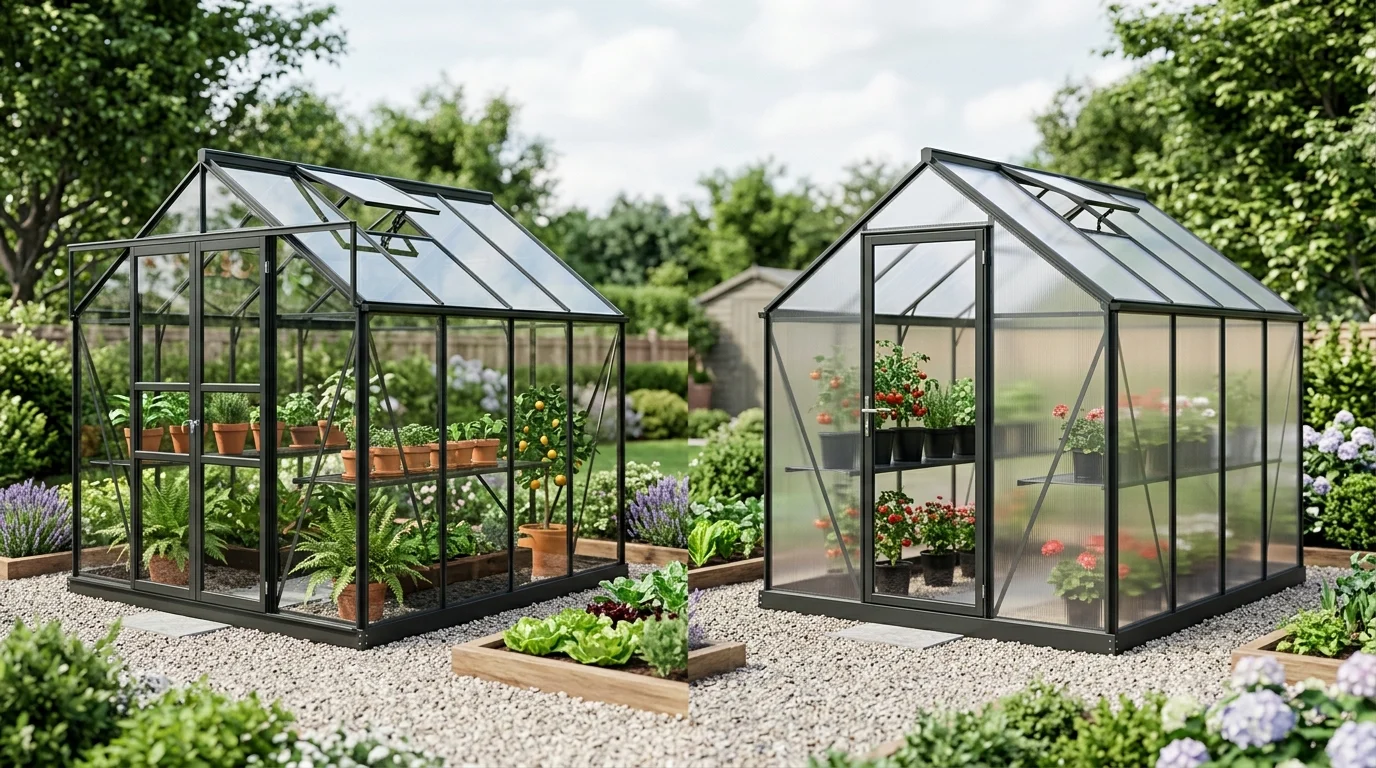
For commercial farming, the choice between glass and polycarbonate shapes far more than a greenhouse’s appearance. It affects light transmission, insulation, durability, maintenance, and ultimately the economics of crop production. The right material can support stronger yields and lower operating costs, while the wrong one can lock a facility into avoidable inefficiencies for years. This comparison explains how each option performs under commercial demands, including climate control, crop type, structural needs, and long-term return on investment. By the end, readers will have a clearer basis for matching greenhouse cladding to production goals, local conditions, and budget priorities.
Why Does Glass Greenhouse vs Polycarbonate Greenhouse Matter for Commerc
Selecting the optimal cladding material is one of the most consequential capital expenditure decisions in controlled environment agriculture (CEA). The debate between a glass greenhouse vs polycarbonate greenhouse extends far beyond aesthetics; it fundamentally dictates a facility's thermodynamic efficiency, light transmission capabilities, and long-term structural integrity. For commercial operators, this decision establishes the baseline for operational expenditures (OPEX) and potential crop yields for decades.
Because cladding influences every aspect of the microclimate, this choice directly impacts the sizing and capacity of internal HVAC, supplemental lighting, and irrigation systems. A mismatch between the greenhouse covering and commercial objectives can lead to systemic inefficiencies, eroding profit margins through inflated utility costs or compromised harvest volumes.
How do crop value, production model, and market requirements
The correlation between light transmission and crop yield dictates that high-value crops require specific environmental parameters to maximize profitability. In commercial horticulture, a widely accepted baseline is that a 1% reduction in Photosynthetically Active Radiation (PAR) equates to a 1% reduction in potential yield for fruiting crops like tomatoes, peppers, and cucumbers. Consequently, production models focused on high-wire, long-season crops prioritize maximum light penetration.
Conversely, production models centered on shade-tolerant crops, leafy greens, or propagation may not require maximum light transmission. In these scenarios, market requirements often prioritize strict temperature stability and lower operational overhead over peak PAR values, which alters the cost-benefit analysis of the cladding material.
Which operating assumptions should commercial growers define bef
Commercial growers must establish rigorous operating assumptions covering a minimum 15- to 20-year horizon before evaluating structural options. Key metrics to define include the target Daily Light Integral (DLI), anticipated seasonal temperature differentials, and the acceptable frequency of cladding replacement. Investors must also forecast localized energy costs, as the structure's thermal insulation properties will compound these expenses over time.
Furthermore, operators must define their risk tolerance regarding extreme weather events and structural degradation. Assuming a 25-year facility lifespan, growers need to calculate the Net Present Value (NPV) of replacing polycarbonate panels every 10 to 15 years versus the higher initial capital expenditure (CAPEX) of a permanent glass structure.
What Are the Core Differences Between a Glass Greenhouse vs
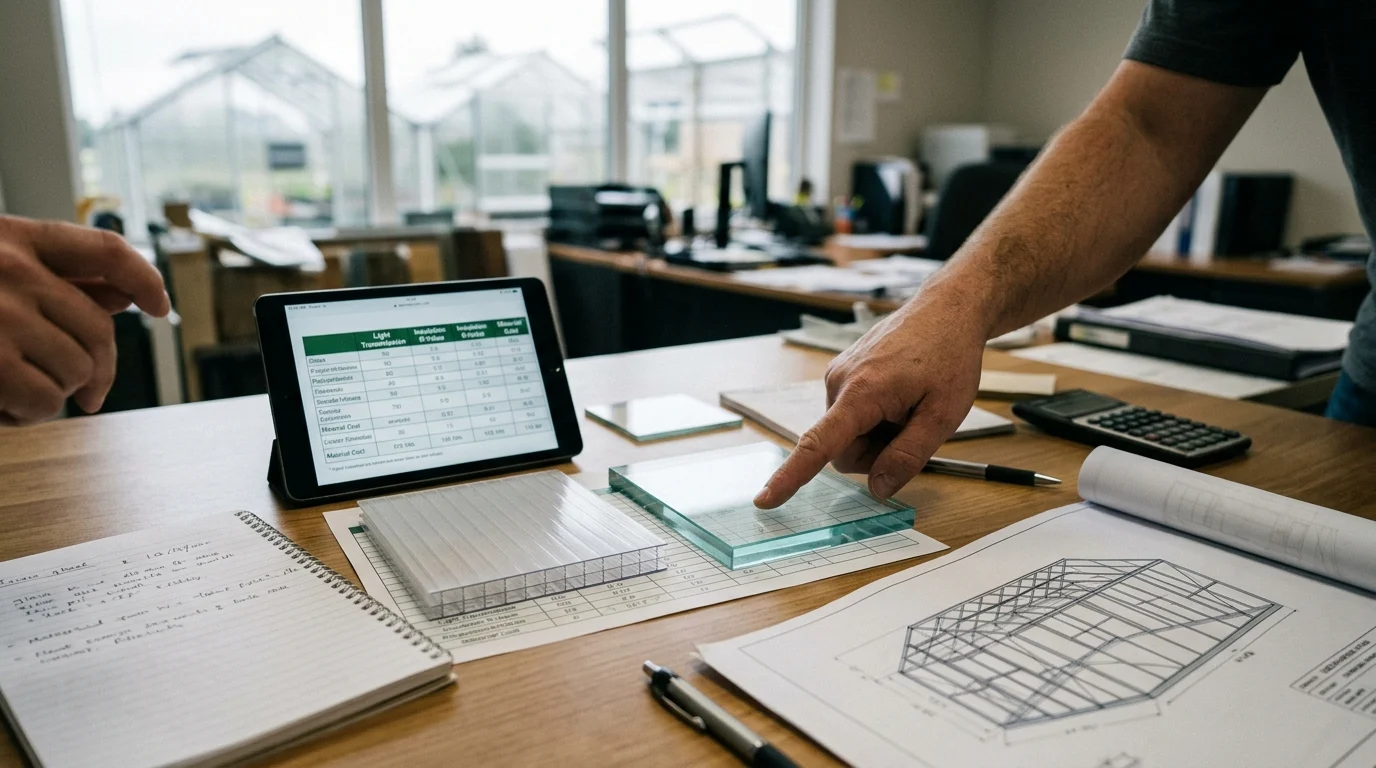
At the structural level, comparing a glass greenhouse vs polycarbonate greenhouse involves analyzing distinct physical properties, load-bearing requirements, and thermal dynamics. The core difference lies in the balance between light optimization and thermal insulation, driven by the inherent material characteristics of each cladding type.
How do material definitions, panel systems, and structural confi
Horticultural glass is typically deployed as 4mm tempered or diffuse panels, requiring robust, heavy-duty aluminum or steel glazing bars to support its substantial weight. Modern glass systems often utilize continuous ridge-to-eave panes to eliminate horizontal purlins, thereby reducing structural shading. Diffuse glass incorporates specialized surface treatments to scatter incoming light, ensuring deeper canopy penetration and reducing localized heat stress.
Polycarbonate, a thermoplastic polymer, is most commonly utilized in commercial greenhouses as multi-wall (twin-wall or triple-wall) panels, typically ranging from 8mm to 16mm in thickness. These extruded panels feature internal flutes that trap air to create a thermal barrier. The panel systems are highly flexible, allowing them to be cold-formed over curved arches (Quonset or Gothic styles) or installed on lighter A-frame structures.
Which performance criteria should be compared first: light trans
Light transmission remains the primary performance criterion for CEA facilities. Standard 4mm tempered glass allows 90% to 97% of PAR to enter the growing environment, maintaining this transmission rate with near-zero degradation over a 30-year lifespan. In contrast, 8mm twin-wall polycarbonate typically offers a baseline light transmission of 75% to 82%, which can degrade by 1% to 2% annually due to ultraviolet (UV) exposure and micro-scratching.
However, when evaluating thermal efficiency, polycarbonate holds a distinct advantage. An 8mm twin-wall polycarbonate panel provides a U-value (thermal transmittance) of approximately 3.0 W/m²K. Standard single-pane horticultural glass offers a U-value of roughly 5.8 W/m²K, meaning it loses heat almost twice as fast as its multi-wall plastic counterpart. This metric is critical for operations in high-latitude climates.
What comparison table best clarifies glass greenhouse vs polycar
To quantify the engineering and performance trade-offs, operators rely on standardized material specifications. The following table highlights the baseline physical differences between typical commercial-grade greenhouse glass and multi-wall polycarbonate.
| Specification | 4mm Tempered Glass | 8mm Twin-Wall Polycarbonate |
|---|---|---|
| Light Transmission (PAR) | 90% – 97% | 75% – 82% |
| Thermal Insulation (U-Value) | ~5.8 W/m²K | ~3.0 W/m²K |
| Material Weight | ~2.05 lbs/sq ft | ~0.33 lbs/sq ft |
| Expected Lifespan | 30+ Years | 10 – 15 Years |
| Light Degradation | Negligible | 1% – 2% per year |
This comparison underscores the fundamental compromise inherent in greenhouse design: operators must sacrifice a degree of thermal insulation to achieve maximum light transmission, or accept lower PAR levels to secure superior energy efficiency.
How Do Costs, Compliance, and Operational Risks Compare in a
A comprehensive financial and risk analysis extends beyond the initial purchase price of the cladding. Commercial viability depends on calculating the total cost of ownership, navigating stringent building codes, and managing the logistical complexities of construction.
How do capital cost, lifecycle cost, repair frequency, and
Capital expenditures for turnkey glass facilities generally range from $40 to $60 per square foot, driven heavily by the massive steel substructure required to bear the weight of the glass. Polycarbonate structures typically require a CAPEX of $20 to $35 per square foot, as the lightweight panels permit the use of less steel and aluminum in the superstructure.
Lifecycle costs, however, narrow this gap. While glass requires minimal replacement over a 30-year horizon, polycarbonate panels must be replaced every 10 to 15 years due to UV yellowing (photodegradation) and reduced light transmission. When factoring in the labor costs of stripping and re-skinning a polycarbonate facility twice over a 30-year period, the lifecycle cost of polycarbonate often approaches or exceeds that of glass.
Which code, safety, fire, wind, snow-load, and food-production c
Building codes strictly regulate commercial agricultural structures, particularly regarding structural loads and fire safety. Glass greenhouses must be engineered to withstand specific regional snow loads—often exceeding 40 pounds per square foot (psf) in northern climates—and wind loads surpassing 100 mph. The rigidity of glass makes it highly resilient to wind deflection but vulnerable to structural shifting.
Fire compliance also differentiates the two materials. Tempered glass is entirely non-combustible, automatically satisfying Class A fire ratings. Polycarbonate is a combustible plastic; while commercial-grade panels are treated with flame retardants to achieve an ASTM E84 Class A rating (flame spread index < 25), some local municipal codes still restrict the total square footage for plastic-clad structures lacking supplemental sprinkler systems.
How do sourcing, transport, installation complexity, and replace
Logistics and installation introduce significant variances in project timelines. Standard 4mm glass weighs approximately 2.05 lbs per square foot, necessitating heavy machinery, specialized vacuum lifters, and highly skilled glazing crews for installation. Breakage during transport and installation can result in a 2% to 5% material loss, requiring strategic over-ordering.
Polycarbonate weighs roughly 0.33 lbs per square foot, allowing for rapid installation by general agricultural contractors using standard lifts. The lightweight nature of polycarbonate significantly reduces freight costs and simplifies the replacement process. However, the internal flutes of polycarbonate require meticulous sealing during installation; failure to properly tape the ends allows condensation and algae growth within the panels, which drastically reduces light transmission and violates strict food-safety sanitation protocols.
Which Commercial Farming Scenarios Favor a Glass Greenhouse vs Polycarbo
Geographic location and specific agronomic objectives ultimately dictate the superior cladding choice. A glass greenhouse vs polycarbonate greenhouse evaluation must be contextualized within regional climate data, specific crop physiology, and local resource availability.
When is a glass greenhouse better for high-light, long-term
Glass enclosures are unmatched in regions with low winter light levels where maintaining a Daily Light Integral (DLI) above 15 mol/m²/day is critical for crop viability. For long-term, high-yield cultivation of vine crops (such as tomatoes and cucumbers) or cannabis, the superior light transmission of glass directly correlates to maximized biomass production.
Additionally, diffuse glass is particularly beneficial in regions with high solar radiation. By scattering direct sunlight, diffuse glass prevents canopy shading and reduces leaf surface temperatures by up to 3°C, minimizing plant stress and preventing tip-burn in sensitive crops.
When is a polycarbonate greenhouse better for climate resilience
Polycarbonate excels in environments prone to severe weather events. With an impact resistance rating up to 200 times that of standard glass, polycarbonate is the standard for regions experiencing frequent, heavy hail. A severe hailstorm can shatter a glass roof, resulting in catastrophic crop loss from both weather exposure and glass shards contaminating the food supply.
Polycarbonate is also the preferred choice in extreme cold climates where the winter temperature differential between the interior and exterior exceeds 40°C. The superior U-value of multi-wall polycarbonate drastically reduces the heating load, preventing energy costs from overwhelming the operational budget during winter months.
How do regional climate, crop type, labor availability, and
Regional labor availability and crop type further influence the cladding decision. Facilities cultivating lower-margin crops, such as bedding plants or seasonal ornamentals, often cannot justify the heavy CAPEX of glass and default to polycarbonate. Conversely, high-tech hydroponic facilities located near urban centers with high labor costs rely on glass to guarantee the maximum possible yield per square foot, thereby offsetting expensive labor.
In high wind zones (e.g., coastal areas with 120 mph wind load requirements), glass facilities offer superior structural rigidity. Polycarbonate panels, if not properly secured with heavy-duty extrusions, are susceptible to wind blow-out due to their lightweight flexibility, potentially exposing the crop to sudden, fatal environmental shock.
How Should Commercial Growers Decide Between a Glass Greenhouse vs
Finalizing the choice between a glass greenhouse vs polycarbonate greenhouse requires a quantitative framework that removes subjective bias. Commercial growers must align their capital constraints with their long-term agronomic targets.
What step-by-step evaluation process should investors, growers
Investors and facility managers should execute a rigorous evaluation process. First, conduct historical DLI mapping and energy cost forecasting for the specific geographic coordinates of the site. Second, engage structural engineers to determine the exact steel tonnage required for a glass versus a polycarbonate facility under local snow and wind load codes.
Third, generate a 20-year financial model that includes the initial CAPEX, projected annual heating costs, and the scheduled OPEX of replacing polycarbonate panels at year 12. If the Internal Rate of Return (IRR) over a 15-year period fails to meet the investor threshold (often 12% to 15%) due to high heating costs, polycarbonate may be mandatory. If the IRR is suppressed by lower total yields, glass is likely required.
Which decision matrix can align budget, yield targets, energy
A weighted decision matrix provides an objective mechanism to align budget, yield targets, and energy consumption. The following matrix illustrates how commercial operators score competing priorities.
| Operational Priority | Glass Greenhouse Score | Polycarbonate Score | Decision Threshold |
|---|---|---|---|
| Maximized Crop Yield (DLI) | High (9) | Moderate (6) | Target DLI > 15 mol/m²/day |
| Energy Conservation (Heating) | Low (4) | High (8) | Winter Delta-T > 30°C |
| Initial CAPEX Constraint | Low (3) | High (8) | Budget < $30/sq ft |
| Hail/Impact Resilience | Low (2) | High (9) | High regional hail frequency |
| Long-Term Asset Value | High (9) | Moderate (5) | Facility lifespan > 25 years |
By assigning localized weights to each of these operational priorities, commercial farming enterprises can definitively determine whether a glass or polycarbonate structure will serve as the optimal foundation for their controlled environment agriculture venture.
Key Takeaways
- The most important conclusions and rationale for Glass Greenhouse vs Polycarbonate Greenhouse
- Specs, compliance, and risk checks worth validating before you commit
- Practical next steps and caveats readers can apply immediately
Frequently Asked Questions
Which greenhouse covering is better for high-value fruiting crops?
Glass is usually better for tomatoes, peppers, and cucumbers because it delivers higher PAR transmission and stable light performance over decades.
When does polycarbonate make more sense for commercial farming?
Choose polycarbonate for colder climates, leafy greens, propagation, or when lower heating demand and lower upfront cost matter more than maximum light.
How much light difference is there between glass and polycarbonate?
Commercial glass typically transmits about 90%–97% PAR, while twin-wall polycarbonate is often around 75%–82% and may decline over time.
Which option offers better insulation and lower heating costs?
Polycarbonate generally insulates better. An 8mm twin-wall panel has a much lower U-value than single-pane glass, helping reduce heat loss in winter.
What should growers compare before choosing glass or polycarbonate?
Define crop type, target DLI, local energy prices, weather risk, and replacement cycle. Then compare long-term CAPEX, OPEX, and expected yield impact.


